Exploring the corporate body | Blog by Kate Swade
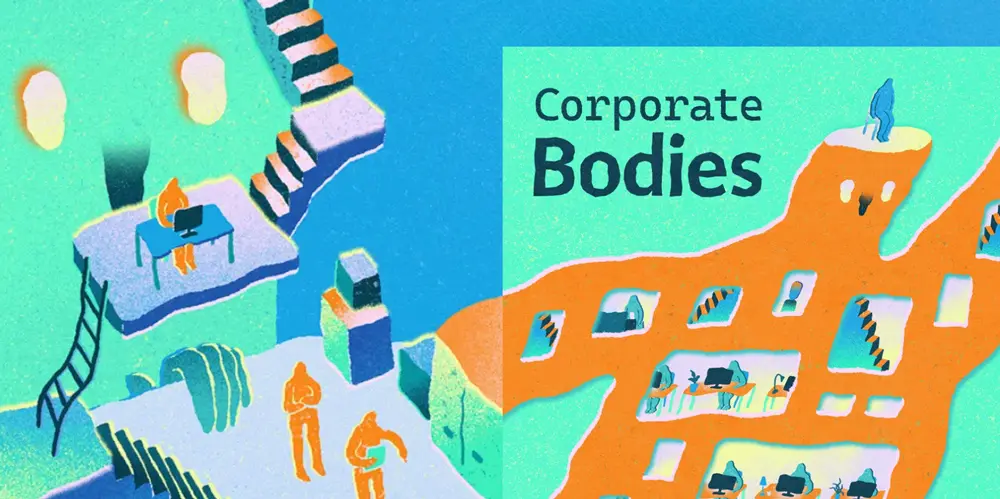
Why are organisations so weird? And what could we do to make them better? Mark Walton and Kate Swade have been exploring just this through their CUSP-supported podcast project, Corporate Bodies.
Blog by Kate Swade
We went into this investigation with a hypothesis—that corporate structures provide useful ways of working together and that working together is made weirder and more difficult by the murky and poorly understood history of incorporation, in particular the idea that companies are legal people.
In other words, that the unexamined organisation may be useful, but may not be worth working for. Throughout the podcast series we have stretched our thinking, and while there’s always more to say, here are some of the key conclusions we’ve drawn:
Organisations are weird—but they don’t have to be
It’s been really reassuring that our starting point of organisational weirdness is one that people really identify with. The main response I’ve got to saying “it’s a podcast about why organisations are so weird”, is some variant of “oh, YES”. It’s a universal experience to find ourselves at sea in a set of strange dynamics that we don’t really understand. It’s also pretty universal that we feel ill equipped to do this—setting up healthy and well-run organisations is definitely not on the school curriculum.
Corporate personhood dehumanises real people
The fact that corporations are legally considered people is what sparked this whole thing—and it’s something we have come back to again and again throughout these conversations. Most of the people we’ve spoken to agree that the impacts of this are at best limiting and at worst deeply toxic and violent.
In our current system, the personhood of the company has to take priority over the individual personhoods of the people within it, meaning that it’s hard to feel safe to show up as yourself at work, especially the further you are from being the “default” professional—white, male, cisgendered, probably middle aged.
We’ve had a lot of fun using the metaphor of the body as a way of structuring this series and our thinking. It’s been helpful to remind us that we humans have bodies too and to make some space for the mess and reality of real bodies. But we do think that both the concept and the metaphor of the legal person limits what we can do and how we can think. So…
Organisations are gardens to tend
We’ve always known that organisations are complex systems. But changing the metaphor from “animating a body” to “stewarding an ecosystem” feels like it unlocks some fertile ground for exploration. It feels much easier to bring your whole energy and personhood to being a steward of a part of a system than it does to being a cog in a machine.
Gardens and other natural systems are also always interconnected with wider systems, and this metaphor gives us space to think about the connections between and beyond organisations, about the kind of organisational infrastructure the world needs for the challenges we face.
Social movements are revolutionising work
A repeated theme was the way that practices from social movement and activist spaces are entering the mainstream world of work. This has always been the case to some extent, but it feels like it has accelerated over the past few years.
Given the state of the world, more and more people are finding themselves in social justice organising spaces, and while these are certainly imperfect, they are great practice grounds for many of the new ways of working that we talk about in the series. Making decisions by consent, talking about power and privilege, even checking in at the beginning of meetings—once you’ve tasted different ways of doing things it can be even more alienating to try and work without them.
Let’s get intimate with work
Another theme that emerged was how much our relationship with our work, with the people we work with and with the corporate body itself, has parallels with our intimate relationships. Concepts like consent—do you consent for me to have this power over you? Do I consent to have it in the first place?—feel like they are under-explored in a workplace setting but could be hugely helpful.
When we join an organisation we are entering into an exponential number of relationships, which we don’t have great ways of thinking about. Are we friends? In what ways might we consider our working relationships ‘intimate’? And what happens when either we decide to leave, or the company breaks up with us? It feels like there’s a whole realm of exploration (and play!) here that could be very helpful. We often default into weird parental-type relationships at work, and there’s loads from the world of psychology that could help us here, not least things like transactional analysis.
The revolution will not be incorporated
This gem of a phrase is from our Episode 10 guest, Esther Foreman, and it feels increasingly true. Certainly, in the UK and the US, the social sector is having a difficult time. We are going to see a lot of organisations close, due to both financial and political pressures, over the next few years.
This will be challenging, but it’s also an opportunity—both to think about what kind of ecosystem we need to tend in order to bring about the changes we want to see—and to reconsider the idea of incorporation itself. The default is so often to set something up—which is then a new garden that needs tending. Can we share our gardens more? How do we ensure that setting up an organisation doesn’t lock us into the system that we are trying to change?
Where should we go next?
We have lots of ideas about where we’d like to take this investigation. We definitely would like there to be a Season 2 of Corporate Bodies, and we are still very open about where it might take us.
Should we explore more some of the cultural, “software” changes we’ve been talking about, perhaps thinking about how they apply in bigger organisations? Should we be diving deeper into the psychodynamics of intimate relationships at work? Should we be thinking about what changes to the “hardware” of corporate structures are needed?
We’ve got a very brief survey here where you can share your views about what you think we should explore.
Related links