From Campus to Capital: Empowering Emerging Nature-Positive Startups
A recent accelerator event showcased how universities can support nature-positive startups by connecting them with investors and bridging critical gaps in the green innovation ecosystem. In recognition of World Micro, Small and Medium-sized Enterprise (MSME) Day 2025, this blog summarises the project and key learnings.
Blog by Robyn Owen, Amy Burnett and Dougal Fleming

Universities have a unique opportunity to drive transformation toward nature-positive economic systems. Through our second SME Nature-Positive Finance Accelerator at Middlesex University, delivered via the Natural Environment Research Council’s Integrating Finance and Biodiversity (IFB) programme, we’ve demonstrated how academic institutions can bridge the critical gap between environmental innovation and investment capital.
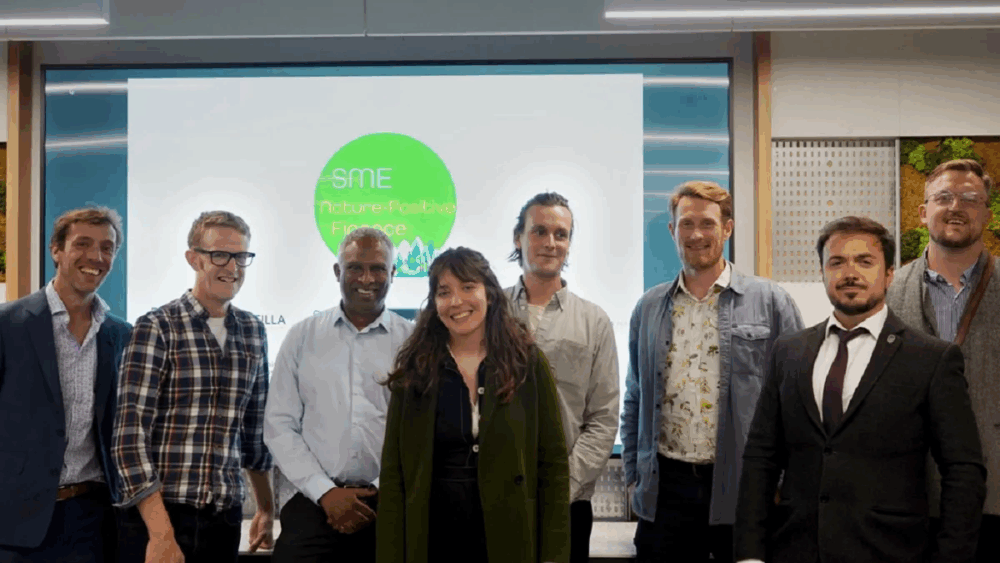
On 15th May 2025, our research team held the second pitching event at Royal Docks Centre for Sustainability, a partnership between Middlesex University and University of East London, as part of our UK university mini-accelerator programme specifically designed for nature-positive SME innovators. This initiative positions the accelerator at the vanguard of advancing SME green finance, looking beyond net-zero to embrace enterprises that actively contribute to the conservation and advancement of natural systems—aligning with the Kunming-Montreal ’30 by 30′ framework.
The Middlesex University research team at CUSP offered a 16-week coaching programme delivering twelve structured sessions through our industry partner Raising Expert and MDX colleagues, alongside leading experts from early-stage professional services (including Scintilla, Founder Catalyst, GrowthMaps and Green Angel Syndicate). Building on our 2024 accelerator experiences, this programme upskilled our selected cohort in key areas of investor readiness and nature-positive business development.
Meeting Budding Nature Market Needs
Our feedback analysis showed that 56% of participating companies were at pre-revenue R&D pilot stage and 78% had already secured some form of grant or equity funding. Critically, 67% had not previously participated in an accelerator programme, highlighting universities potential to serve first-time entrepreneurs in this emerging sector, which is amplified when working with industry experts.
The 2025 cohort exemplifies the breadth of nature-positive innovation opportunities, spanning circular economy, regenerative agriculture, sustainable transportation, and clean technology applications. Our companies included:
- Asteroid Cargo Bikes – produces flexible split-frame e-cargo bikes with hub steering systems to address urban logistics challenges and last-mile delivery solutions
- Blast Studio – transforming coffee cup waste into ‘Cupsan’ architectural materials and furniture
- BubbleLife – biodegradable seaweed-based packaging solutions addressing plastic pollution in hospitality
- Greenleaf Surgical – recyclable NHS surgical gowns with polymer tracking technology
- JIREH – 3D printing solutions – converting the UK wood waste to create innovative 3D furniture components and engineered products
- LifeSaver Power – manufacture of power banks for on-the-go device charging in public spaces, events and festivals that support UK-based renewable energy systems
- Optimal Cities – the first all-in-one digital planning platform integrating satellite intelligence and GeoAI to revolutionise urban planning
- TierraSphere – biomineralisation technology transforming food waste into carbon-sequestering soil enhancers
- Intellidigest (2024 cohort) – food waste elimination and upcycling to support sustainable food systems
Addressing Communication Gaps
Our research reveals that 27% of participants identified “finding the right language that resonates with investors” as their primary challenge, with 19% struggling to “find investors who value biodiversity impact.” These findings highlight fundamental communication gaps in the nature-positive investment ecosystem—precisely the type of market failure that universities are well-positioned to address through evidence-based programme design. The feedback validates our approach: 80% prioritised “improving my pitch to investors” as their primary programme motivation, while 70% sought to “improve the financial case for my business” and “develop a more compelling narrative around environmental impact.”
The feedback from the cohort reveals the huge distance travelled by the cohort from the programme in terms of understanding what nature-positive means to their business proposition, identifying biodiversity opportunities, making nature-positive connections, confidence articulating their ideas to investors and considering “nature as a customer” and how to measure this and seek appropriate nature-sensitive investment opportunities.
Innovation Through Academic-Industry Partnerships
To advance these goals, we’ve co-developed the innovative Nature-Positive Business Mapping Toolkit with Ollie Bream-McIntosh (Raincoatfish) and Catherine Wilder (Nodl Tech). This interactive tool helps SMEs understand their nature value and successfully embed this into their business model, equipping them with strategies to convey this to investors, supply chains and potential clients. We are currently testing the tool and our team are very exciting about its potential to support enhanced value and strategy towards nature-positive action and are seeking to support SMEs align to key frameworks like the Taskforce for Nature-related Financial Disclosures and other emerging sustainability frameworks. This work will be greatly enhanced through collaboration with our MDX-IFB Fellow Dougal Fleming’s biodiversity mapping research.
The University Advantage
Universities possess unique assets for supporting nature-positive entrepreneurship: research credibility to validate environmental claims, educational expertise to develop investor literacy, and convening power to bring together diverse stakeholders. Our programme model demonstrates that academic-led accelerators can effectively prepare nature-positive SMEs for investment while upskilling emerging businesses to demand that investors integrate environmental considerations into their decisions.
As CUSP Research Fellow Dr Amy Burnett notes, “Programmes such as the nature-positive accelerator can change the dial on how our economic systems are structured to protect and enhance the natural systems on which we depend.” At our pitch event, investors were clearly impressed with companies’ deep knowledge of complex issues such as Intellectual Property and their well-considered responses to challenging investor inquiries.

Looking Forward
Our accelerator—with several companies securing follow-up investor meetings and enhancing capacity to engage in ongoing funding relationships—demonstrates universities’ capacity to support entrepreneurship in this critical sector. As the funding landscape for universities continues to change, there’s a massive opportunity for higher education to embrace their role as anchor institutions, becoming catalysts for systemic economic transformation toward nature-positive outcomes. Middlesex University’s partnership to support students and the local community to be part of the local What’s Your Big Idea accelerator scheme demonstrates the potential of place-based approaches to upskill the community to catalyse positive change.
Academic institutions can effectively bridge innovation-investment gaps and convene different actors to align SMEs and local economic systems with impactful regulatory frameworks in the transition to a nature-positive economy. There is also great potential for students to learn from these experiences and to provide real-time analysis as learning partners on this exciting journey, which the team at CEEDR and GreenFin Research are seeking to encourage with the student and alumni community.
This text also appeared on the Middlesex Minds website.
Related links