Action to Transform the UK Food Systems: innovations for an alternative
The UK food system faces rising health and environmental costs. Evidence from the TUKFS Programme outlines systemic changes for a sustainable future. In this blog, CUSP deputy director Fergus Lyon summarises key findings.
Blog by Fergus Lyon
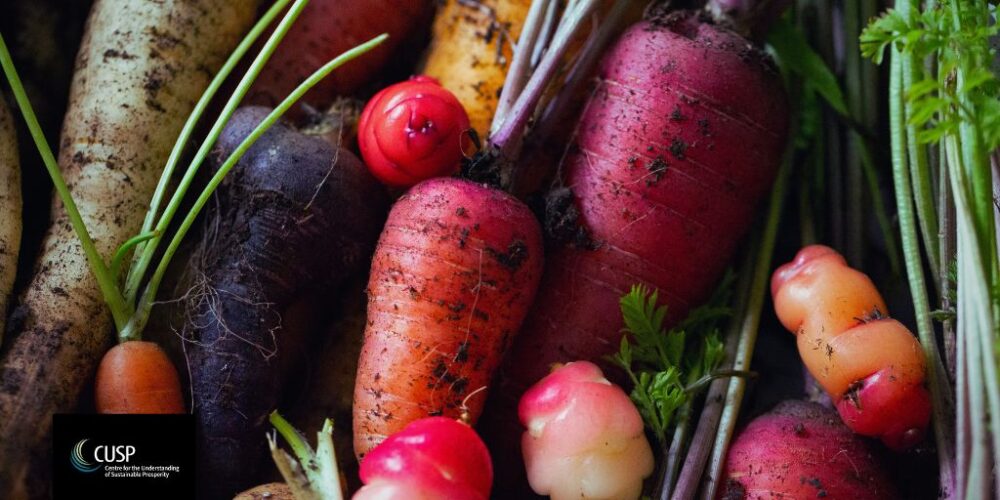
Food is at the heart of our health, our environment, and our economy. Right now, the UK food system is driving ill health and environmental damage, presenting huge costs for the all—but it doesn’t have to be this way.
We contributed to new research identifying 27 practical action areas to make food fairer, greener, and more resilient. This is not just about better food products, but also about changing behaviour and fostering social innovations for alternatives. It forms part of our wider work on food systems engaging policy makers in Westminster, and developing good practice guides for social enterprises.
Proposed actions include supporting long-term regenerative farming trials, incentivising UK-grown pulses, legislating for redistribution of surplus food, subsidising healthier diets, embedding co-production in decision-making, and establishing a permanent cross-government food systems body.
If implemented, these measures could improve health, cut emissions, restore ecosystems, and build resilient communities and economies. We present these idea in a groundbreaking synthesis of evidence from the UK’s Transforming UK Food Systems (TUKFS) Programme, outlining a bold roadmap for transforming how food is grown, processed, traded, and consumed—with human and planetary health at its core.
Middlesex Researchers also led on complementary research published in the Philosophical Transactions of the Royal Society on social innovation, showing how institutional, cultural, and participatory practices are essential to embed and sustain systemic food transformation.
Funded through a £47.5 million UKRI Strategic Priorities Fund investment, the TUKFS Programme brought together interdisciplinary teams, food system actors, communities and policymakers across the UK to identify 27 actionable “levers” for change.
Key Messages & Findings
The UK food system is at a crossroad: It is a major driver of climate change, biodiversity loss, soil degradation, and noncommunicable disease. In the UK, diet-related disease accounts for an estimated 15 % of adult mortality, and 26–30 % of greenhouse gas emissions stem from food systems.
Transformation requires more than isolated fixes: Piecemeal interventions are insufficient. A holistic, systems-level approach is needed, one that links changes in production, processing, consumption and governance, guided by co-design with those most affected.
Social innovation is an enabler, not optional: New institutional models, participatory governance, shared values, and socially embedded experimentation can help accelerate adoption, legitimacy, and resilience of food system change.
27 levers for change, across five themes. Some standout examples include:
- Production: Support long-term, co-designed regenerative agriculture trials (10+ years), peer learning networks, and independent agronomic advice.
- Supply & processing: Incentivise UK pulse cultivation, promote shorter and more localised supply chains, expand digital tools for resilience, and legislate the redistribution of surplus food.
- Food environment: Scale supermarket interventions (e.g. nudging healthier choices), simplify labelling, subsidise healthy foods through voucher schemes, and adjust portion norms.
- Communities: Foster locally embedded social enterprise models, rebalance power in supply chains to reward sustainable producers, and make co-production the default decision process.
- Policy & governance: Promote systems-based policy design, align local and national strategies, establish a permanent cross-government food systems body, enforce public procurement standards, and embed collaborative evaluation practices.
Risk and barriers remain. These transitions take time, and their social and environmental outcomes must be funded—through fairer food prices for farmers or alternative forms of support. However, longer-term savings are evident from shifting to healthy, sustainable food.
Collaboration is key. Bringing together large corporations with smaller producers and enterprises is essential. Unequal power dynamics and exclusion of marginalised voices have long hindered progress and must be proactively managed.
Policy coherence and consistency are critical. Disconnected policymaking and short funding cycles remain major obstacles. Social and technological innovations require long-term support and policy engagement that goes beyond parliamentary cycles.
If adopted at scale, these levers can help the UK move beyond incremental reform toward genuine transformation—improving public health, restoring ecosystems, cutting emissions, and nourishing resilient economies and communities.
About the Projects & Authors
The TUKFS Programme brings together researchers, local actors, and policy partners across the UK to co-design and evaluate food system innovations in place-based contexts. Research on “Exploring social innovation for transforming food systems” contributes conceptual and empirical insights into how institutional and social change processes can enable food transitions. It was authored by Fergus Lyon, (Middlesex University), Bob Doherty (York University), Katerina Psarikidou (University of Sussex), Ian Vickers (Middlesex University) and Alise Kirtley (University of Sussex).
Related links