Re-imagining a new economy that works for all people and the planet
Ben Kellard et al
CUSP Working Paper Series | No 44

Summary
The need for a new economy
Wellbeing feels out of reach for most people. This paper explores why this is and an alternative economic model that can deliver wellbeing for all.
Social and environmental wellbeing includes feeling secure and part of healthy communities with meaningful fairly paid work that allows time for friends, family and a fulfilling life. This includes a stable climate and access to nature, clean air, energy, water, housing and healthy food.
The economic model that has dominated for the last fifty years assumes markets are the best way of deciding whose needs get met and how. This assumes that money is the measure of wellbeing, leading governments to prioritise growth and companies to maximise making money. This creates structures and incentives that require, especially Private Equity or publicly listed businesses, to do three things:
- Get as much output from as little labour as possible
- ‘Externalise’ costs by passing them onto nature and society, at no cost to business
- Use advertising to create insatiable wants to maximise the volume of consumption
These combine to create an extractive ‘work and spend’ society that designs-in inequality and insecurity, tending towards low-paid, long-hour work, and the over- consumption of ‘take-make-waste’ and built-to-break products that pollute our skies, land and waterways. These outcomes directly undermine social and ecological wellbeing. Is there an alternative economic model that keeps what works in the current system, while designing-in wellbeing?
What might a new economy look like?
There is a diverse range of economic approaches where the economy serves the wellbeing of people and the planet, referred to here as a new economy. This recognises how people are a part of—and dependent on—nature and each other for their flourishing. In a new economy each economic actor has important interdependent functions to play, that can be summarised as:
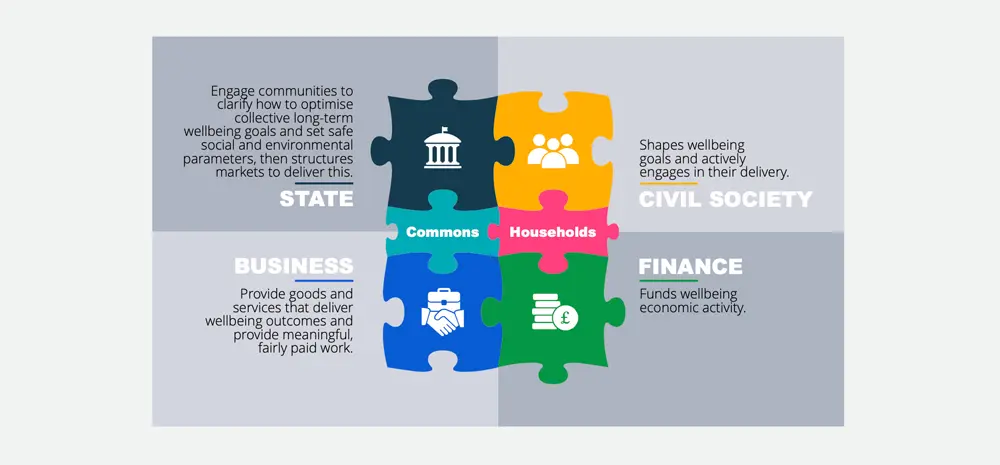
While there isn’t a ‘one size fits all’ new economy, this paper sets out some of the key interdependent functions that each actor in the economy might play. This is intended to inform and inspire a public debate on what economy we want and how to transition to it.
1 Introduction
As the world faces multiple crises, or polycrisis, identifying what prosperity is, how to deliver it and for whom, is arguably the most pressing issue of our time. Most of the downstream outcomes of economic activity are caused by the upstream design of the economy that creates structures, cultures and incentives that drive these outcomes. However, these upstream design principles are often overlooked, with public debate focusing on the downstream effects, such as the cost of living or carbon emissions.
This paper seeks to summarise the current upstream design principles and bring together research for an alternative economy that would serve people and the planet. This focuses on re-imagining the role of economic actors. The intention is to inform public debate on what form of prosperity we want and what economy might deliver that. This can be used as an accessible, credible, evidence-based alternative view of the economy that can be used to engage and inspire a wide range of citizens and leaders to see the urgent need to transition the economy and find their role in it.
There are a diverse range of economic approaches1 designed to deliver wellbeing for all people and the planet, what is referred to here as a new economy. A group of predominantly European2 leaders in their fields representing many alternative economic approaches, including representatives from government, business, finance and civil society came together to identify shared foundational principles for a new economy and the typical functions of key economic actors. The principles for a new economy align with those that resulted from Wellbeing Economy Alliance’s previous wider consultation.3
2 Why we need a new economy
Social and environmental wellbeing4 includes feeling secure and part of healthy communities with meaningful fairly paid work that allows time for friends, family and a fulfilling life. It includes a stable climate and access to nature, clean air, energy, water, housing and healthy food. This is supported by both global surveys5 and human needs theories such as Max-Neef 6 and Ian Gough7. However, this feels out of reach for most people. Why is that?
An economy is a social provisioning system, based on underlying beliefs. The upstream design of economies starts with foundational assumptions, or tenets. Our current economy assumes: people are greedy, selfish, solitary, rational and separate and superior to nature. Money is the measure of wellbeing and price equals value. Markets are the most efficient way to create and distribute goods and services and the best place to get our wellbeing.
These tenets lead to cultures, structures and policies that expand markets and— crucially—allow markets to decide what gets produced and how and who benefits from them.8 There is a view that the government’s role is to fix market failures and provide basic services that aren’t profitable enough for the market to provide. Financial value becomes the single metric of success for the private and public sector (GDP: the economy’s total goods and services). This leads to Growthism, where economic growth and financial value almost become ends in themselves.
At the organisational level, this requires9 businesses—especially large publicly listed or Private Equity owned—to maximise their profits and growth, further enforced by financial institutions that seek to maximise financial value, that in turn require maximising shareholder returns. This incentivises and requires businesses to do three things:
- Get as much productivity from as little labour as This tends to create insecure long hours, low pay,10 stressful work environments, employing as few people as possible. This is likely to be exacerbated as AI is deployed at scale.11
- ‘Externalise’ costs by passing them onto nature and society, at no cost to For example, pollution or obesity from sugary foods or unpaid care work. These combine to destabilise our climate,12 destroy nature13 and weaken communities. This includes corporations minimising their tax payments.14
- Use advertising to create insatiable wants to maximize the volume of This, combined with point 2, leads to the overconsumption of ‘take- make-waste’ and built-to-break products.
Failure to grow has very real punitive implications for leaders of publicly listed or Private Equity owned companies, who’s decisions shape their supply chains, often made up of smaller businesses.
At the societal level, as markets expand to become the dominant provider of goods and services, they shape society though the markets of both labour and goods and services. These three organisational responses combine to create an extractive, high- carbon15, high-waste16, ‘work more, spend more’ society with scarcity, inequality17, the destruction of nature and perpetual dissatisfaction18 designed-in to fuel competition and growth. As a tool for maximising turnover of goods and services, the $676bn19 global advertising industry sells us a vision of affluent prosperity based on owning material things, despite this having been shown to reduce levels of wellbeing.20
At the economic level, investment and innovation flow to where financial value is maximised, usually seeking productivity gains, especially in labour. This productivity is measured by total output, or GDP, that measures neither stocks (such as forests or community health) or sinks (such as landfill or Greenhouse Gas Emissions), only economic throughput that has a price, not distinguishing its value to society or nature. GDP therefore only captures the partial cost, not the benefit, of economic activity. Nature and society are treated as infinite sources and sinks for materials, labour and waste.
Market consolidation has also led to a small number of huge businesses with the economic power to shape markets and influence governments to create policies and shape institutions to enable further market expansion. For example, just seven
companies represent 62% of the Nasdaq Stock Market’s top 100 companies21 and 10% of households own over 90% of the stock market.22
Resources flow to where the greatest profits can be maximised, rather than to social needs that underpin wellbeing. This also leads to lean, fragile, unequal, value chains, that focus on efficiency with large centralised players.23 Extreme inequality is created within and between countries in terms of wealth, power and environmental impact.
For example, the richest 10% create two thirds of global carbon emissions.24
At the political level, states come under pressure to grow GDP (that is assumed to raise living standards and tax for public services) by expanding markets and investing in society. For example, the huge expansion of Private Equity owned housing, infrastructure, care and other public services.25 States are also influenced by powerful businesses to adopt policies that expand markets further, such as reducing tax and regulation. This can reduce tax revenues at a time when more public services are needed to deal with the externalised costs from the current economic model, resulting in indebted governments.
While this economic model has raised living standards for many, it has done so by creating huge inequality and destabilising nature through its combined effects that are now undermining the foundations of wellbeing for humankind and nature,26 including worsening mental health trends.27Many of these dynamics are summarised below at a high level:28
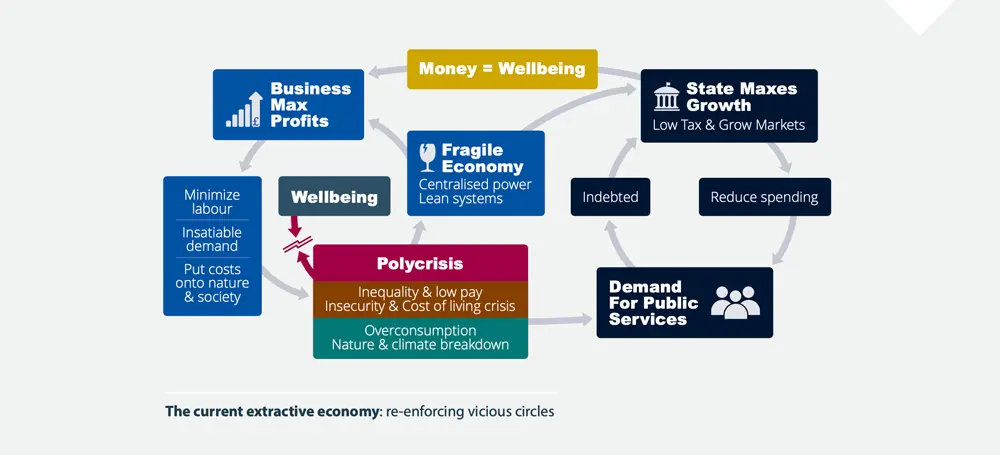
The old economic design creates outcomes that are in direct conflict29 with social and environmental wellbeing,30 set out at the start of this section. Our current economic model is taking us to a place most people don’t want to go.31 In summary, the misalignment between economic and wellbeing outcomes are driven by three main upstream flaws in the old extractive economy:
- Equating wellbeing with money misses the true drivers of wellbeing
- Overlooks the power dynamics in markets and the influence of elites
- Separates the economy from social and environmental stocks and sinks. 32
This results in a materially affluent model of prosperity, based on the extraction of materials, labour and finance, that is delivering downstream outcomes that are undermining the very foundations of wellbeing and markets and only delivers short- term benefits for the few.
This way of organising the economy has dominated for over fifty years, but is no longer fit for purpose and it is time we collectively redesign it. This is especially urgent in the middle of the ‘decisive decade’33 of the 2020s.
So how would an alternative economy be designed, that does take us where we want to go?
3 A new economy—that serves people and planet
There is a diverse and robust range of evidence and practice that shows us what a new economy can look like. However, this diversity can also seem fragmented. This section seeks to bring together this rich field, by surfacing its common ground.
3.1 Foundational tenets of a new economy
A new economy is based on certain evidence-based upstream tenets:34
People are part of nature and dependent on it and on each other.
Wellbeing lies in the flourishing of relationships between people and between people and the natural world. When people feel secure in their basic needs, such as housing and healthcare, they are freer to use their creative energies to support each other’s flourishing and that of all life on this planet.35
Communities thrive when they have a voice over their collective destiny and find belonging, meaning and purpose through genuine reciprocal connection to people and the planet that sustains them.
Society is a complex system embedded within the natural world. Societal success is delivering shared wellbeing for current and future generations.
The economy is another complex provisioning system that is interconnected and embedded within society and also dependent on and part of the natural world. This nested relationship is illustrated below.36

3.2 Purpose and principles for a new economy
The purpose of a new economy is to serve the long-term wellbeing of people and the planet. This creates an economy that enables everyone to thrive, along with nature, driven by the needs of the people within their geographical and cultural place and context.
There is no one single blueprint for a new economy. There are also a rich and diverse range of approaches and policies that can be selected to transition towards a new economy. The transition doesn’t need to be ‘all or nothing’, there are a range of options that can be taken towards a new economy. The Wellbeing Economy Alliance have identified, from these diverse approaches, five common needs37 that a new economy meets:
- Purpose: institutions serve the common good and create real value
- Participation: citizens are actively engaged in their communities and locally rooted economies
- Dignity: everyone has enough to live in comfort, safety and happiness
- Fairness: justice is at the heart of the economy
- Nature: a restored and safe natural world for all life.
4 What might a new economy look like?
New economy policies, rules and incentives are designed to enable government, companies, non-profits, commons and citizens to optimise their contribution to a world where everyone can live in comfort, safety, and flourish in harmony with the rest of the natural world. Whether we are seeking to transition a city, sector or whole economy, it’s important to be able to re-imagine how economic actors might work differently together. Otherwise, we can fall back on outdated roles. Unlike today, where the market provides most goods and services, in a new economy this provision would be more evenly distributed across economic actors.
A new economy ‘designs-in’ downstream wellbeing outcomes that can be illustrated as:
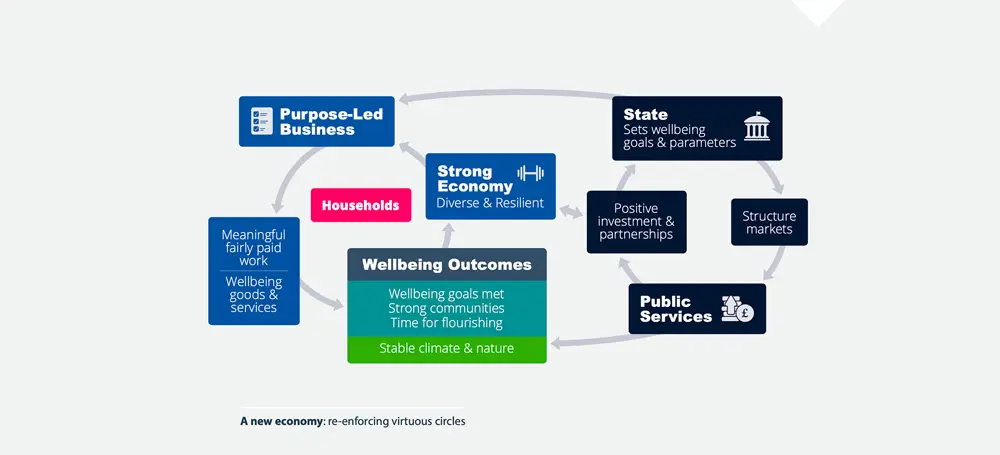
Informed by Kate Raworth’s Embedded Economy,38 this section sets out the complementary, credible, interdependent functions that key economic actors might play in a new economy.
These functions can be summarised as:
The following is not a comprehensive list, but rather a summary of the typical complementary functions found in practice and the literature.
4.1 Households
Households are described by Raworth39 as the ‘core economy,’ where care, nurturing, and the essential work for human wellbeing takes place. This includes raising children, emotional support, caring for the elderly, and maintaining homes, activities often undervalued in traditional economic models as they aren’t priced into the market.
Households provide the foundation for all other economic activities, as they support individuals who participate in markets, commons, and state activities.
4.2 Civil society functions
Citizens and Civil Society have a critical role to play in both shaping the state’s understanding of their wellbeing and supporting the delivery of the subsequent wellbeing goals and holding the state to account. This includes freely expressing their needs and aspirations to governments through participatory democratic approaches, that complement representative democracies.
They can also be actively involved in building community as well as finding and creating meaningful work,40 through various organisational and ownership forms.41 These combine to build trust and a sense of agency, identity, belonging and accountability to contribute to their communities.
The role of citizens include:
- Engaging in culturally appropriate forums and channels (such as citizen assemblies) to express and explore diverse views and values which then inform their personal views and help governments to understand citizens’ essential needs and aspirations and co-develop policies to deliver them
- Identifying what underpins their wellbeing in terms of common goods and how these can be satisfied (such as specific types of education and housing) and shape a narrative that directly informs the government’s wellbeing goals, vision, strategy and decision-making.
The role of civil society includes:
- Holding other sectors and actors to account for protecting their fundamental rights and delivering the state’s wellbeing goals, strategy and policies—including clarifying the funding required
- Taking part in social groups and contribute to societal resilience, such as a crisis response to support community groups
- Creating, promoting and engaging in diverse forms of providing goods and services, such as co-operative businesses, home ownership models and social enterprises42
- Helping people to enjoy life and find belonging and meaning by bringing them together through communities, culture, sports, and shared activities.
4.3 State functions
States are responsible for assuring fundamental rights and the wellbeing of their people: the bedrock of democratic societies. This involves aligning all innovation and economic activity towards delivering high levels of wellbeing and universal human rights, while ensuring healthy natural and climate systems. This puts wellbeing at the heart of its vision, strategy and policy. The distinctive functions of the state as an actor in a new economy are to:
- Actively engage communities to understand their wellbeing This informs the wellbeing goals, parameters and indicators for the economy. This clarifies what wellbeing is and becomes the ends for the economy
- Set parameters the economy needs to operate within, such as environmental limits that reflect the science, with levels of income and wealth differentials
- Align the rules of the economy, including policies, structures, regulation and incentives, to shape markets to deliver the wellbeing goals within the defined parameters—including determining which economic activities need to grow and which need to be reduced
- Ensure all organisations, including the state itself, provides a distinctive, optimal strategic contribution to the long-term wellbeing of all people and planet, through its purpose43
- Develop a vision, strategy and transition plan for delivering essential goods, services and infrastructure the government will provide, invest in or subsidise so that citizen’s wellbeing can be optimised. This enables a diverse provision of goods and services from households, governments and commons, as well as the market
- Align National Accounts with the wellbeing measures to enable oversight and accountability for progress towards the wellbeing goals and keeping within This in turn informs strategy and enables trade-offs to be optimised and justified. Align organisational accounting and disclosure obligations for all sectors with these National Accounts.
While this will require the state to have a strong relationship with its people and the ability to shape the economy to serve their needs, it doesn’t follow that it needs to be a large state. That depends on the strategies the state selects to deliver the wellbeing goals within the parameters. States would select strategies from across its policy levers44 to deliver the goals, that may include:
- Building the capacity within government and the public sector to deliver the wellbeing goals and manage the transition and required partnerships
- Facilitating and shaping partnerships that incentivise, scale and deliver innovation and attract investment that balance risks and rewards between the partners45
- Designing and stewarding public finance, including procurement, to enable the transition to the wellbeing goals that attracts innovation and private investment
- Ensuring that the regulation and incentives for accessing private finance is aligned to funding the wellbeing goals, within the parameters, that may include a credit and investment guidance framework46
- Ensuring fiduciary duty is mandated to consider the organisation’s distinctive long-term contribution to wellbeing within set parameters, where finance is a necessary means to that end
- Stewarding the transition to the wellbeing goals, that balances competing interests, trade-offs and power relationships, bringing the voices of marginal or vulnerable groups to the fore.
4.4 The Commons
The commons47 refers to resources that can be managed collectively by communities, such as public parks, community gardens or shared digital platforms. These are not private property but are accessible to all members of the community. The commons offer a model for resource management that can avoid the ‘tragedy of the commons’ through self-organising and community-based governance, rather than relying solely on privatisation or state control. This can apply to natural commons, such as forests and parks as well as digital (e.g. data) and even money commons.
4.5 The Market: business functions
The business community has a critical, creative and vibrant role in delivering society’s needs, crucially, aligned to wellbeing goals and parameters. This alignment builds trust with society and allows businesses to be stewards for the next generation. This enables businesses to create true long-term wellbeing for society in a profitable way within bounded competitive markets. The functions of business include:
- Providing a distinctive, optimal strategic contribution to the long-term wellbeing of all people and planet, through its purpose, including societal priorities defined by the state’s wellbeing goals48
- Adopting leading organisational governance standards49 that includes clarifying its purpose and how the strategy delivers it within safe parameters for nature and society while ensuring more democratic governance with diverse representation from its key stakeholders impacted across its value chain
- Providing products and services that enable customers’ wellbeing, within the government’s parameters, such as circular, regenerative and socially inclusive
- Creating meaningful and purposeful work and cultures that values the dignity and diversity of people, while fairly and equitably rewarding employees
- Collaborating openly with peers, communities and other sectors and government to deliver systems-level solutions that deliver wellbeing, such as raising standards, shaping regulation and scaling innovation
- Embracing participatory leadership and governance structures that empowers and devolves decision-making to those closer to the stakeholders they are serving50
- Ensuring that finance serves the organisational purpose
- Aligning metrics and incentives with the organisational purpose that serves wellbeing, ensuring transparency and accountability.51
Supported by government regulation, these functions enable a diverse range of business types, in terms of sizes, cultures and forms of ownership.
4.6 The Market: finance functions
Public and private finance has a key role to play in funding wellbeing goals, creating true long-term value. This pulls forward future risk and attracts public and private investment that works for the long-term and drives capital towards regenerative, inclusive and productive activity. This would require a smaller, simpler and less leveraged financial sector that is more diverse and resilient. Finance becomes the means, or plumbing, for anew economy rather than an end in itself. It conveys savings and credit into mechanisms to deliver long-term social and environmental value in the real economy.52 It is also not reliant on expanding debt53 and growth to function. In addition to the functions of business above, the functions of finance include:
- Financial institutions adopting an integrated value approach (that measures social and natural value as well as financial) to inform all decisions to deliver real economy wellbeing outcomes, including analysis of investment options and the allocation, pricing and structuring of capital54
- Providing inclusive products and services that provide the flows of financial capital to the real economy to deliver wellbeing goals and raise financial literacy
- Aligning the financial structure with the wellbeing goals and parameters, including monetary policy, banking rules and supervision
- Ensuring the managers of capital align their incentives and investment decisions with the long-term wellbeing of their beneficiaries
- Becoming active agents55 in collaborative strategies to create the conditions and incentives for long-term wellbeing, in the service of the state’s wellbeing goals
- Redefining debt and perceptions of risk between the Global North and South to ensure a more equitable burden that recognises the colonial legacy of current debt burdens.
Productivity in a new economy is measured by how effectively a wellbeing goal is achieved within the social and environmental parameters.
Each economic actor is dependent on the others to play their role in a new economy. This requires those actors to work together to enable the transition. We hope this paper provides some of the scaffolding needed to re-imagine what those roles could be.
5 International governments and trade
While there isn’t space to do justice to the role of international trade and governments, it’s acknowledged that the current growthism model has come from and compounded historic extractive practices and deepened existing inequalities within and between countries. This includes between northern and southern hemisphere countries, supported by the Washington Consensus56, that imposed free market policies on low-income countries, contributing to unequal exchange57 between the regions.
Transitioning to sustainable global prosperity will require high-income countries to reduce overconsumption and inequality while transitioning to regenerative clean production, while low-income countries can ‘leapfrog’58 the old high carbon and materially intensive industrial economies by developing the clean regenerative infrastructure they need to deliver their wellbeing goals. Both will need to develop sustainable forms of production that meet the needs of the many, not the few.
New economy approaches can assist this transition in several ways, supporting sovereignty and self-determination. Firstly, by providing an evidence-based vision for prosperity that emphasises common needs and connection over extraction and material prosperity. Secondly, while each economy will determine their own wellbeing goals, it can also enable the identification of shared wellbeing ‘ends’ between countries and regions. As opposed to focusing on ideological differences and national interests that compete over the means to material growth. Finally, it enables leaders to work back from shared ends to complementary and equitable industrial policies that can achieve them.
Some wellbeing goals and parameters (such as emissions restrictions) will need to be set at a global level. This is likely to require a ‘nesting’ of some wellbeing goals and parameters at global, regional, national and local levels.
This paper aims to summarise the root cause of the crises we face today and why the old economy is neither delivering wellbeing today or able to in future. It provides a credible, evidence-based, scalable alternative that aligns the economy with wellbeing. What is set out here is far from where most economies are today. The transition to a new economy will require trade-offs and transitioning from growth dependencies, such as government borrowing59. Barriers and enablers to the transition to a new economy have been identified60, that include the need for compelling narratives.
This paper provides the foundation for a forthcoming narrative designed to help employees and citizens to understand the need to transition the economy and find their role in it. This includes joining the many initiatives and examples61 of the emerging new economy at a regional, national, city, sector or organisational level.
We hope you’ve found this an informative and inspiring contribution to the debate and we’d welcome your feedback, via Ben Kellard.
6 Summary of key shifts to a new economy
This table captures and contrasts the key assumptions across the continuum of thought on the purpose of economies.
| To a new economy | |
| People are greedy, selfish, solitary, rational, competitive, insatiable and separate and superior to nature. | People are empathetic, relational, reciprocal, interdependent, purpose-driven and are part of and dependent on nature. |
| Prosperity is achieved primarily by accumulating material goods and financial wealth. | Prosperity is achieved by advancing human wellbeing, including through connecting with oneself, others and nature. |
| The purpose of the economy is to allocate resources to make money. | The purpose of the economy is to optimise the long-term wellbeing of people and the planet. |
| The measure of success is GDP/financial value. Money equals wellbeing and price equals value. | The measure of success is wellbeing for people and the planet, measured through key people and planet wellbeing indicators. |
| States’ role is to fix market failures and provide unprofitable services. Maximise market freedom and minimise the public domain. | States guarantee fundamental rights and engage communities to clarify how to optimise collective long-term wellbeing and then structure markets to deliver this. In doing so, states set the ends for the economy. |
| Markets decide ends based on what will maximise profits and are the main provider of goods and services. | Markets are a means to delivering the ends, along with households, states and commons. |
| Business is there to provide goods and services that maximise profits. | Business is there to provide goods and services that deliver wellbeing outcomes and provide meaningful fairly paid work. |
| Equity– allows the market to distribute resources according to price, even if this leads to inequality. | Equity– the economy is designed to optimise everyone’s wellbeing. |
7 Workshop attendees
The following people attended a workshop in London in March 2025, to identify the common principles of a new economy that serves people and planet. In alphabetical order:
- Alexander Bryan, University of Cambridge, Philosopher of political philosophy and ethics
- Alvaro Alvarez, Freelance documentary & filmmaker on DeGrowth
- Ben Kellard, Convenor
- Ben Taylor, Partner, EY, Climate Change and sustainability services
- Dan Gray, contributor to EY’s A New Economy report
- Deborah Gilbert, Director, ShareAction
- Dee Corrigan, Facilitator · Coach · Community Convenor
- Emmie Bidston, Oxford Character Project & Harvard Flourishing project
- Esmé Clifford Astbury, Policy Director, ReGenerate
- Prof Fergus Lyon, Centre for the Understanding of Sustainable Prosperity (CUSP)
- Gary Gillespie, Chief Economist, Scottish Government
- Gaya Herrington, Author and public speaker on moving from “Never enough” to “Enough for each”
- Hans Stegeman, Chief Economist, Triodos Bank
- Jeremy Nicholls, Social Value International, UNDP, Capitals Coalition & A4S
- Jo Swinson, Director at Partners for a New Economy
- John Granholm, NED, business advisory, former Asset Manager
- Jonathan Tench, Wellbeing Economy Director, Office of the Future Generations Commissioner for Wales
- Jonathan Wise, co-founder of Purpose Disruptors
- Karl G Burns, former Head of HR, Vodafone
- Katherine Trebeck – author of The economics of Arrival and co-founder of WEAll
- Micael Johnstone, advisor on future of business strategy
- Mohammad Jamei, Director of Economic Policy, Confederation of British Industry
- Oliver Dudok van Heel, author of An Economy That Works– Aldersgate Group
- Richard Hardyment – Institute of Business Ethics, author of ‘Wellbeing Purpose’
- Sophie Saxe Gripenberg, Economy for the Common Good & Wellbeing Economy Alliance Sweden
- Susie Abson, Head of Future Economy, Welsh Government.
- Till Kellerhoff, Director, Club of Rome
- Dr Victoria Hurth, Convenor of standards to enable the Wellbeing Economy
- Xiaoting Hou-Jones, Government & Policy lead, Doughnut Economics Action Lab.
8 Contributors
The following people kindly provided feedback on this paper. In alphabetical order:
- Aileen McLeodv, Director, Wellbeing Economy Alliance, Scotland
- Amanda Janoo, Economics & Policy Lead, Wellbeing Economy Alliance
- Christian Felber – founder of the Economy for Common Good
- Dimitri Zenghelis– Special Advisor for the Wealth Economy Project
- Frances Rayner, Comms & Narratives Co- Lead at Wellbeing Economy Alliance
- John Rosling, CEO at Contexis
- Mads Falkenfleth, Founder & Director at Wellbeing Economy Lab
- Margreet Frieling, Knowledge Co-Lead, Wellbeing Economy Alliance
- Mario Martínez Lorenzo, President at Dinero Positivo
- Neus Casajuana, REVO Prosper
- Paul Donaldson, Global VP Strategy at Anheuser-Busch InBev
- Sarah Davidson– CEO, Carnegie UK
- Susana Martín Belmonte, Economist, Researcher and Monetary Innovator.
References
- For an inductive scoping analysis of a broad range of new economy schools of thought, identifying ten principles across these NE approaches, please see Kenter et al 2025: https://www.academia.edu/127324695/Ten_principles_for_transforming_economics_in_a_ For an in-depth analysis of specifically beyond-growth approaches to the science of wellbeing within planetary boundaries, see Kallis et al 2025: https://www.sciencedirect.com/science/article/pii/S2542519624003103
- See section 7 for a list of workshop attendees
- https://weall.org/what-is-wellbeing-economy
- https://earth4all.life/global-survey-2024/
- https://www.gallup.com/workplace/237020/five-essential-elements.aspx
- https://pure.eur.nl/en/publications/understanding-max-neefs-model-of-human-needs-as-a-practical-toolk
- https://academic.oup.com/cje/article-abstract/39/5/1191/1696582
- For example, the UK food industry is estimated to create food-related costs of chronic disease of £268billion. See: https://timjackson.org.uk/ffcc-report-big-food/
- Through a range of explicit (laws, incentives, metrics, structures) and implicit (narratives, behaviours, culture)requirements
- Tepper & D. Hearn, The Myth of Capitalism: Monopolies and the Death of Competition, (Wiley, 2018)
- https://tech.co/news/half-ceos-replace-jobs-ai
- https://www.ipcc.ch/report/ar6/syr/summary-for-policymakers/
- https://www.worldwildlife.org/publications/2024-living-planet-report
- https://itep.org/amazon-avoids-more-than-5-billion-in-corporate-income-taxes-reports-6-percent-tax-rate-on-35-billion-of-us-income/
- https://ourworldindata.org/co2-emissions
- Global plastic production: https://ourworldindata.org/grapher/global-plastics-production
- https://www.oxfam.org/en/takers-not-makers-unjust-poverty-and-unearned-wealth-colonialism
- https://cusp.ac.uk/themes/aetw/consumerism_disappointment/
- https://www.imarcgroup.com/global-advertising-market
- The Problematic Role of Materialistic Values in the Pursuit of Sustainable Well-Being. https://www.com/1660-4601/19/6/3673
- https://www.bankrate.com/investing/magnificent-7-stocks/
- https://fortune.com/2024/01/13/how-rich-wealthy-stock-market-investors-inequality-day-traders-record-high/
- https://www.monbiot.com/2022/05/20/contagious-collapse/
- https://www.independent.co.uk/climate-change/news/global-warming-carbon-emission-rich-vs-poor-tax-b2745446.html
- https://www.ft.com/content/7da72f9c-978b-41e7-8e4b-478818f7456f
- For example, according to the WWF there has been a 73% decline in the average size of global wildlife populations in just 50 See https://wwf.panda.org/wwf_news/?12179466/LPR-2024
- https://lealmind.com/global-mental-health-statistics-2025/
- This is not a comprehensive illustration of an economy, rather a summary of key assumptions, actors, impacts and their relationships
- https://efi.ed.ac.uk/systems-working-against-each-other/
- Jackson, Prosperity Without Growth, (Routledge, 2009/2016)
- https://earth4all.life/global-survey-2024/
- https://www.gov.uk/government/publications/final-report-the-economics-of-biodiversity-the-dasgupta-review
- https://iop.harvard.edu/events/decisive-decade- climate-action
- The Economics of Arrival: Ideas for a grown-up economy by Katherine Trebeck and Jeremy Williams, (Policy Press, 2019).
- https://weall.org/what-is-wellbeing-economy
- Informed by the work of Herman Daly, see Energy, Economics, And The Environment, (Routledge, 2019)
- https://weall.org/what-is-wellbeing-economy
- Raworth, Doughnut Economics (Penguin, 2018) Chapter 2
- See footnote 38
- https://cusp.ac.uk/themes/p/blog-iv-pathways-to-good-work/
- See 1 at: https://www.climateactionleeds.org.uk/post/beyond-inclusive-growth-a-community-wealth-building-economic-framework-for-leeds
- https://cusp.ac.uk/themes/aetw/innovation-for-wellbeing/
- Aligned with the International standard for Purpose Driven Organisations ISO 37011: https://iso.org/standard/86112.html
- https://openpolicy.blog.gov.uk/2020/03/06/introducing-a-government-as-a-system-toolkit/
- Mazzucato, Mission Economy: A Moonshot Guide to Changing Capitalism,(Penguin, 2022)
- https://www.jasonhickel.org/blog/2024/8/20/credit-guidance-how-we-achieve-degrowth
- https://weall.org/commons-in-the-wellbeing-economy-paper-launch
- Aligned with the International standard for Purpose Driven Organisations ISO 37011: https://iso.org/standard/86112.html
- Aligned with the International standard for Organisational Governance ISO 37000: https://iso.org/ISO_37000_Governance
- https://weall.org/the-business-of-wellbeing-new-guide-launches-today
- See: 6 Accounting for impact & ROI in https://weall.org/the-business-of-wellbeing-new-guide-launches-today
- Raworth, Doughnut Economics (Penguin,2018) Chapter 6
- https://www.sciencedirect.com/science/article/pii/S2214629623003122
- https://www.clubofrome.org/publication/earth4all-rothenberg/
- https://www.unepfi.org/industries/the-future-of-investor-engagement-a-call-for-systematic-stewardship-to-address-systemic-climate-risk/
- https://www.intelligenteconomist.com/washington-consensus/
- https://www.nature.com/articles/s41467-024-49687-y
- The Economics of Arrival, (Policy Press, 2019),by Katherine Trebeck and Jeremy Williams, Chapter 7
- https://cusp.ac.uk/themes/aetw/wp43/
- https://www.clubofrome.org/publication/earth4all-trebeck-wellbeing-economy/
- https://weall.org/case-studies
The full paper is available for download in pdf (1.4MB). | Please cite as: Ben Kellard et al 2025. Re-imagining a new economy that works for all people and the planet. CUSP Working Paper No 44. Guilford: Centre for the Understanding of Sustainable Prosperity.
Acknowledgements
This paper has been developed in collaboration with a range of leaders who attended a workshop and provided editorial guidance. In alphabetical order: Alexander Bryan, Alvaro Alvarez, Ben Kellard, Ben Taylor, Dan Gray, Deborah Gilbert, Dee Corrigan, Emmie Bidston, Esmé Clifford Astbury, Prof Fergus Lyon, Gary Gillespie, Gaya Herrington, Hans Stegeman, Jeremy Nicholls, Jo Swinson, John Granholm, Jonathan Tench, Jonathan Wise, Karl G Burns, Katherine Trebeck, Micael Johnstone, Mohammad Jamei, Oliver Dudok van Heel, Richard Hardyment, Sophie Saxe Gripenberg, Susie Abson, Till Kellerhoff, Dr Victoria Hurth, Xiaoting Hou-Jones. A number of contributors also provided their input. The workshop attendee descriptions and contributors are named in section 8. Graphics were provided by David Holmes and Linda Geßner. The paper was created by an unfunded coalition of the willing.
Webinar
To accompany the paper, and foster further discussion, we hosted a webinar. The recording of which can be accessed below or via YouTube directly.