The Fast and the Furious
What is economic growth really measuring? It’s not just numbers – it’s speed and acceleration. Using the metaphor of economies as cars on a racetrack, Smith Mordak explores how even small growth rates can widen global inequality – and why rethinking the pace and rules of growth is more urgent than ever.
Blog by Smith Mordak
When economists talk about ‘economic growth’ they are usually referring to the economic growth rate. Expressed as a percentage (%), this is the rate at which the economy is getting bigger, or smaller.
The economy is a flow of money, measured as “output (the goods and services produced in the economy), expenditure (money invested by businesses and spending by households and government) or income (business profits, household income and government tax take)” (ONS). In theory, with perfect data, all those ways of measuring GDP would add up to the same number. We don’t have perfect data so an average is taken to give us our best guess. Every which way, though, this is a measure of money flowing through the system.
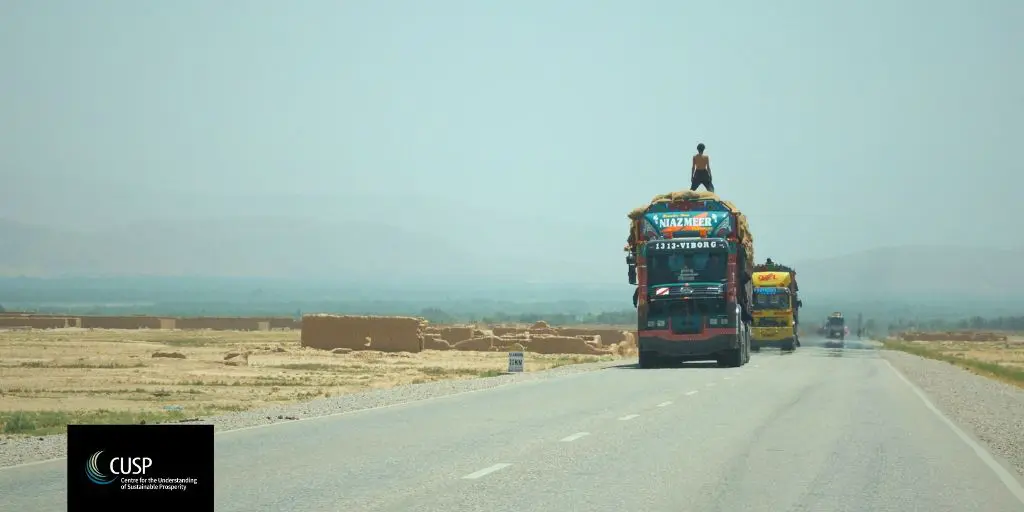
We can think of this flow of money as the economy’s speed. Let’s imagine each country as a car, and the size of their economies as the speed of their cars. A ‘fast’ economy like the US is racing along at $85,800/person/year, a ‘slow’ economy like Afghanistan is crawling along at $413/person/year (2024 figures from World Bank). The fastest car in the world has a theoretical top speed of 330mph. If the US car were travelling at 330mph, Afghanistan would be travelling at 1.59mph, half the average walking speed of an average adult human.
But this is just the size of the economy. Growth rates are measured in %, equivalent of the acceleration of our hypothetical cars. In 2024, the global growth rate was 2.9% (World Bank). If the Afghanistan car were speeding up at this rate then it would be going at the incrementally faster 1.63mph next year. If the US car were speeding up at 2.9% then next year it would have sped up from 330mph to 340mph. So while the economic growth figure of 2.9% looks the same, the effect is hugely different with the Afghanistan car speeding up by less than 0.05mph year on year, and the US car now 10mph over the world’s fastest car.
In reality, different countries grow at different rates, in other words accelerating with more or less horsepower. So things can even out, right? Let’s say the US economy stopped growing and just cruised along at 330mph, while the Afghanistan car keep speeding up at 2.9% a year. It would take the Afghanistan car 187 years to reach 330mph, by which time the US would be over 260 million miles ahead – that’s more than 10 times around the equator. Talk about an unfair lead.
Let’s give the Afghanistan car a better shot. The country with the highest consistent GDP growth over the last 10 years is India with 6.3% (Ray Dalio’s Great Powers Index). If the Afghanistan car sustained 6.3% annual growth a.k.a. acceleration, it would still take 88 years to reach 330mph by which point the US car would still be over five laps of the Earth ahead.
All this is to say that while economic growth figures of 2.9% or even 6.3% can feel like pretty small and innocuous numbers, when we recognise them as acceleration, and pair them with the speed of various economies, we can see their impacts are not at all innocuous, but in fact profound and pretty terrifying.
It’s not simple to slow down safely. Slowing down too abruptly is a car crash. We’re reliant on keeping up the pace unless we inflate some airbags through social policies and regear our vehicles with changes to arbitrary fiscal rules. But things as they are, are also very unsafe. Some of the worst off are poor folks in the rich economies, where trying to survive is like cycling on a motorway.
Why should some populations be tearing up the tarmac while others aren’t even at walking pace? Why is it not reasonable to suggest that the fastest economies slow down a bit and let others plug their cars into the EV charging points and pick up some speed? The horrific working conditions of cobalt miners in the DRC is just one example of how we are quite literally bullying people in ‘slower’ economies for the benefit of the acceleration of already much ‘faster’ ones. Those toiling for the benefit of the fast have every right to be furious.
Why do we even want to be travelling so fast? It’s so hectic, aren’t we all exhausted? Interestingly, we often hear that an economy is ‘slowing down’ but rarely that it’s ‘speeding up’. Perhaps because we all know in our souls that speeding up is not necessarily a good thing for an economy. A merry-go-round spinning faster and faster and faster is the stuff of nightmares. The faster everyone’s going, the more dangerous it gets, as we know from the horrific pile up known as the Global Financial Crisis of 2008. It’s not safe on our roads. People are dying. It’s time for a redistribution of energy such that everyone can travel at a safe speed in a comfortable vehicle, and a rewrite of the global economic Highway Code.
Related links