Can we really have green growth?
Has economic growth really been decoupled from climate damage? In this blog, Simon Mair examines recent claims from the Energy and Climate Intelligence Unit that growth and emissions are no longer linked, arguing that while decoupling is real, it is happening far too slowly to avert catastrophic climate change.
Blog by Simon Mair

Can we really keep making and consuming more stuff, and avoid catastrophic climate change? This debate is old, but ever present. A recent report from the Energy and Climate Intelligence Unit argues that the debate is over, in the words of one of the authors:
“We’re sometimes told the world can’t cut emissions without cutting growth. The opposite is happening. Decoupling is now the norm, not the exception—and the share of the global economy that is decoupling emissions in an absolute sense is steadily increasing.”
This has been taken up in the press, notably in this Guardian article which declares that the link between economic growth and climate change has been broken. The implication is that we don’t need economic transformation to deal with climate change: we’re on the right path already.
As attractive as this idea is, it is simplistic, and misleading. While decoupling trends are good, they are not good enough.
First, the good news: there are very encouraging trends in the data. Seeing an increasing number of countries absolutely breaking the link between economic growth and emissions is significant and welcome. It is not unexpected—Vogel and Hickel documented the same trend in 2023, albeit for fewer countries. It is also good news that the rate of growth of carbon emissions is slowing.
But. The story remains a story about growth in global carbon emissions. A slower rate of growth is much like a fall in the inflation rate—it signals moderation, not decline. When inflation slows, your food still costs more to buy, it just costs less than it would have done if inflation had been higher. Likewise the amount of carbon emitted into the atmosphere is still going up. It’s just going up by less than it did previously. While this is good news, there remains a big difference between going up less, and going down.
Historically, growth has been a major driver of emissions. As I have argued elsewhere, we can understand the relentless expansion of fossil fuels over the last 200 years as the result of chasing profits and growth. Over this same time period we have vastly improved both energy and carbon efficiency. But these gains have been overwhelmed by growth in the scale of economic activity. We can demonstrate this with a simple counterfactual.
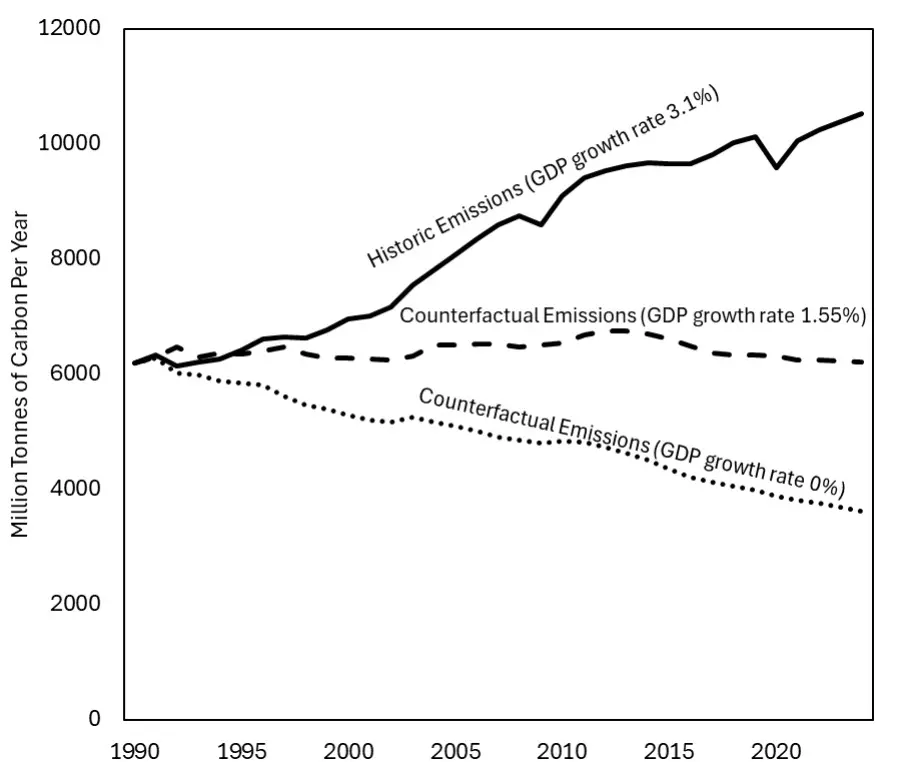
Using the same data as the Post-Paris report, the solid black line on chart below shows the actual carbon emissions from the global economy since 1990, when the average annual growth rate was ~3.1% The dashed line shows the emissions if we had made the same progress in carbon efficiency, but economic growth had been only 1.55% and the dotted line shows emissions if there had been no growth.
My intention here is not to say that we should have had no growth since 1990. Nor do I want to argue that post-growth is a panacea. The central challenges for post growth are around ensuring equity and quality of life. Much work tackles this (e.g. Fearon et al., 2025 and Gräbner-Radkowitsch and Strunk 2023), but I’m not getting into it in this short post.
I simply want to point out that growth has acted to absorb the potential gains from efficiencies. Even with absolute decoupling, this remains true. It is why the only time we have seen an absolute decline in global carbon emissions is during recessions: the global financial crisis, and covid lock downs. (Check out the timing of the dips on the figure above: 2008 and 2020). At these moments efficiency gains were able to be channelled into carbon reductions, rather than simply slowing the rate of growth.
Now you might reasonably say: that is the past, what about the future?
The same basic dynamic holds true. If the global economy continues to grow we will have to decarbonise faster than if it did not grow. Fundamentally, the question is one of time scales: how fast and how hard do we want to decarbonise?
This question illustrates that focussing on growth raises serious challenges for environmentalists, particularly ecological economists. When ecological economists talk about growth, we are really concerned with scale. Growth is a flow variable—it measures the rate of change over time. The central thesis of ecological economics is really about the absolute size of the economy (which in system speak is a stock variable) relative to natural systems. If the economy stopped growing tomorrow, the sheer size of it would still make decarbonising fast enough to save the small island states an unimaginably huge endeavour.
What we see in the data is that decoupling is happening far too slowly to avoid catastrophic climate change. This is for two reasons. First, although the headline is about absolute decoupling (where emissions decline as the economy grows), much of the story is still actually about relative decoupling (where emissions grow more slowly than the economy). This is what we see in China. Second, even where we see absolute decoupling, it is happening too slowly. Even with absolute decoupling, the vast majority of global economic activity is dependent on fossil fuels.
There are reasons to be concerned about our capacity to keep decarbonising at the rate we have—work we’re currently doing with WISE focusses on the idea that it is possible we’re seeing the results of low hanging fruit: shifts from coal to gas, decarbonisation of easy to decarbonise sectors etc. driving an overall decarbonisation rate that masks slower rates of progress in hard to decarbonise activities—sectors that will become more important as quick wins slow down. I also (in a much looser and more vibes-based sense) have concerns about how an increase in energy intensive processes like AI and military production, might change the calculus of the last 10 years.
There is a rhetorical lesson for environmentalists here: we need to think about how we shift from growth to scale. The reasons for engaging with “growth” rather than scale is primarily political—growth is a focus of governmental policy and the cultural rhetoric of capitalism. No-one really thinks about scale, everyone thinks about growth. So, talking about growth is a good way to start a conversation about scale, but it does allow reports like this one to focus on a slowing of the growth rate as a good news story, minimising the fact that the absolute scale of economic activity and the absolute amount of carbon in the atmosphere remains incredibly high and is getting bigger.
As a closing note then, I want to emphasise that even with developed nations decoupling, we have a mountain to climb and the mountain is growing. If we could stop the mountain growing that climb gets easier. If we can cut the top off the mountain, it would get easier still.
Related links