Londa School of Economics, not the LSE you are thinking about: Why New Economic Thinking Can—and Must—Begin at the Margins
This blog introduces A New Economic Grammar from the Inner Areas, the first working paper of the Londa School of Economics, rethinking economics from rural and marginalised places beyond global financial centres. It sets out a vision based on care, shared prosperity, and ecological regeneration in response to climate breakdown and inequality.
Blog by Dario Leoni
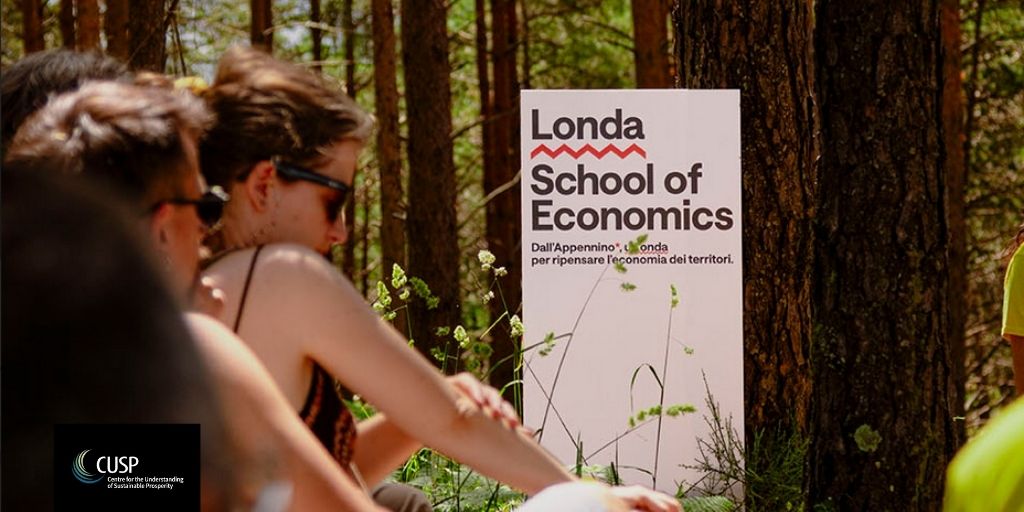
What if the future of economics did not come from the world’s great financial centres, but from places often labelled as ‘peripheral’? What if the most compelling answers to today’s crises—climate breakdown, inequality, weakening of democratic values, and social fragmentation—were being shaped not in London, but in Londa, a rural town in the middle of the Tuscan Apennines?
This is the provocation at the heart of A New Economic Grammar from the Inner Areas, the first working paper of the Londa School of Economics. The paper is both an intellectual manifesto and an open invitation: to rethink economics from the ground up, starting from places that have historically undergone a challenging process of economic marginalisation, yet are rich in social, ecological, and cultural capital.
Why Londa School of Economics? In 2008, Queen Elizabeth II famously asked economists at the London School of Economics why they had failed to foresee the then unfolding financial crisis. In 2009, a group of prominent UK economists and commentators wrote a letter replying to the Queen’s 2008 question, acknowledging that many experts had indeed failed to predict the timing and severity of the crisis. In their view, this was due (among other reasons) to an inability of financial and economic pundits to see the broader picture. More than a decade later, despite new courses on sustainability and green finance, mainstream economics is still making the same mistake, failing to grasp the deep, systemic causes behind the ecological crisis, and its interconnectedness with the other crises listed above.
In response to this systemic failure, LAMA—an Italian social cooperative which has worked in sustainability projects for the past 20 years—has developed a network of public and private institutions, practitioners and academics to envision a new economics school, located outside of the centres of global capitalism, which could finally produce more satisfactory answers. The Waldensian church generously financed the initiative. The small town of Londa offered the perfect starting point. Set in a rural, mountainous territory, it is a symbol of the many ‘inner areas’ across Italy and in the rest of the world. These places are marked by depopulation, fragile services, and economic marginalisation, but also resilience, experimentation, and innovation. The School’s intuition is that these areas should not be seen as leftovers of development, but as laboratories for new economic imaginaries. Its goal is to enhance the vitality and dignity of Tuscan Apennine communities.
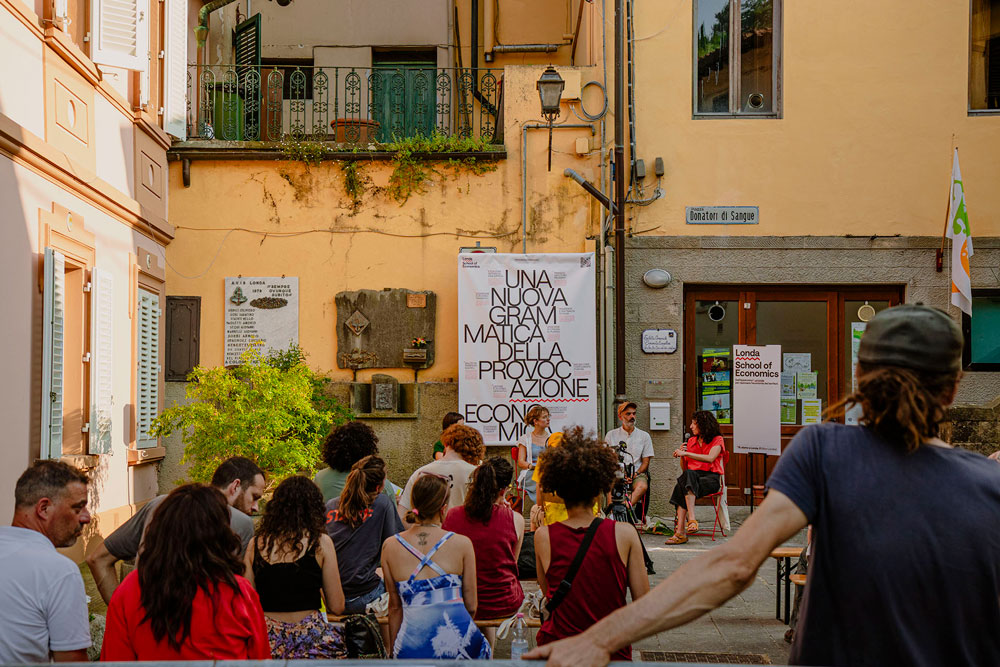
The vision of the School is thoroughly articulated in the working paper and it is strongly aligned with the vision of CUSP. The starting point is the fundamental rejection of the false equivalence between human progress and endless economic growth. The continuous expansion of the economy no longer guarantees well-being, and in many cases actively undermines it. Inspired by the work of many radical ecological economists, the paper advocates a shift from an economy obsessed with accumulation to one oriented toward shared prosperity, sufficiency, and care. At the heart of the working paper is the proposal of five guiding principles for a new economic grammar:
- The economy is prosperity – not just profit, but collective, long-term well-being.
- Together is better – cooperation, commons, and shared values over competition and isolation.
- Health is well-being – recognising the deep links between human, social, and ecosystem health.
- The Earth is common – moving beyond environmental extraction toward regeneration and shared stewardship.
- Governing is a shared responsibility – developing institutions that foster trust, accountability and inclusion.
These principles are not abstract ideals. The paper grounds them in values, real-world practices, and policy directions—from ethical finance and cooperative ownership to agroecological transitions, energy communities, and new forms of shared administration.
This first working paper is the result of a collective effort by the School’s scientific committee and advisors, drawing on diverse research areas and expertise. I have the pleasure of being part of the committee, and I had the opportunity to contribute to the economics section of the paper, aligning them with CUSP values. However, as A New Economic Grammar from the Inner Areas is the basis on which the courses of the School are modelled and designed, we want to make it as inclusive and participatory as possibly. We have thus explicitly conceived it as a living document. The paper is open to discussion, critique, and contribution from scholars, practitioners, students, activists, policymakers, and all those interested in reimagining the economy.We invite you to read the working paper or the sections aligned with your interest and/or expertise, share your reflections, and contribute ideas, cases, and perspectives. Use the comments to engage with the arguments, challenge assumptions, or propose additions. A new economic grammar can only emerge through dialogue, and we want to hear your voice.
Related links