
BLOG
The Breakthrough Institute asserts that ecomodernism can give us a “Good Anthropocene”. But in aiming at a second naivete of progressive modernism, it mistakenly treats nature as though it were a human creation.

Endless economic growth, long the rallying cry of the conventional paradigm, endangers our future. Ecological economist Tim Jackson, CUSP Director and author of Prosperity Without Growth, explores the need to envision a post-growth economy with Allen White, Senior Fellow at the Tellus Institute.
In his guest blog, Dan Bailey discusses the role and necessity of the welfare state in ensuring the democratic legitimacy of the transition to ‘sustainable prosperity’. He writes here about the welfare state in the context of prolonged austerity and the political revolts of the Trump vote and Brexit referendum, and in dialogue with different streams of work within CUSP.

As part of its involvement in CUSP, the Aldersgate Group is launching a one-year project to understand how to increase private investment in green infrastructure. In her blog, project lead Alex White explains how we will be looking at the most material barriers and considering the solutions to incentivise greater investment in the projects that will underpin the UK’s upcoming policy packages.
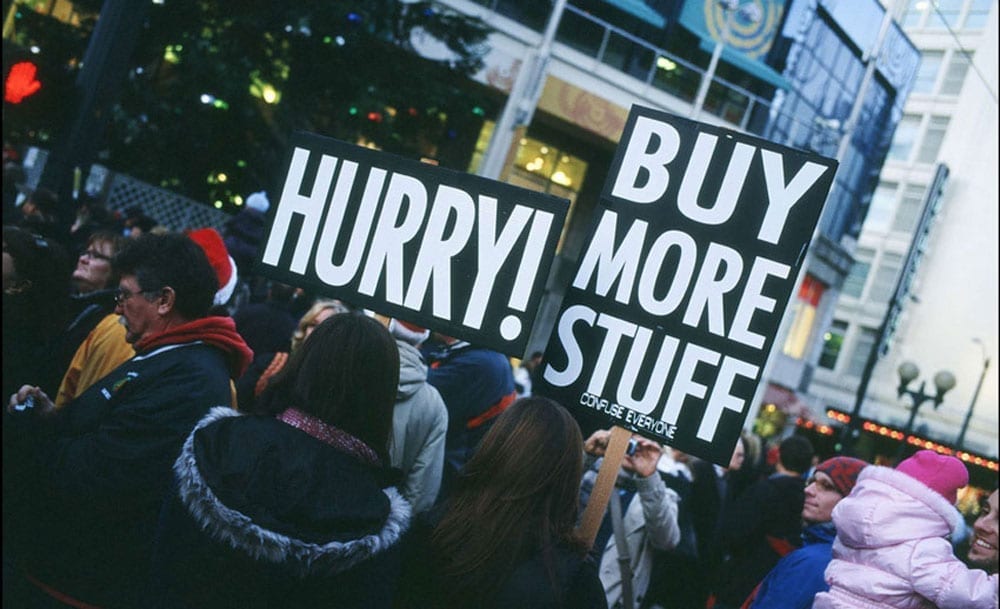
Consumerism is deeply problematic, but despite its obvious limitations, harms and absurdities, it is remarkably difficult to displace as our default societal setting and plot. Consumerism has become our prevailing cultural and economic modus operandi and is fundamentally more logical than it might at first appear.

Adventures in the Anthropocene—the fourth book discussed in the Anthropocene Reading Group—stands out from the others as the first that might be taken to the beach. Gaia Vince’s intrepid reportage has won her generous reviews. Yet, the journalistic and scientific objectivity—the twin lenses of her investigation—comes at a price, Robert Butler finds.

Documentary photographer and CUSP fellow Kerstin Hacker is investigating the developing consumer culture of Lusaka (Zambia) and examines photographically the emergence of a new cultural sector. Her project is set out to enable artists to participate meaningfully in the debate around sustainability and prosperity of the sector and the country as whole. In this blog she introduces her work.
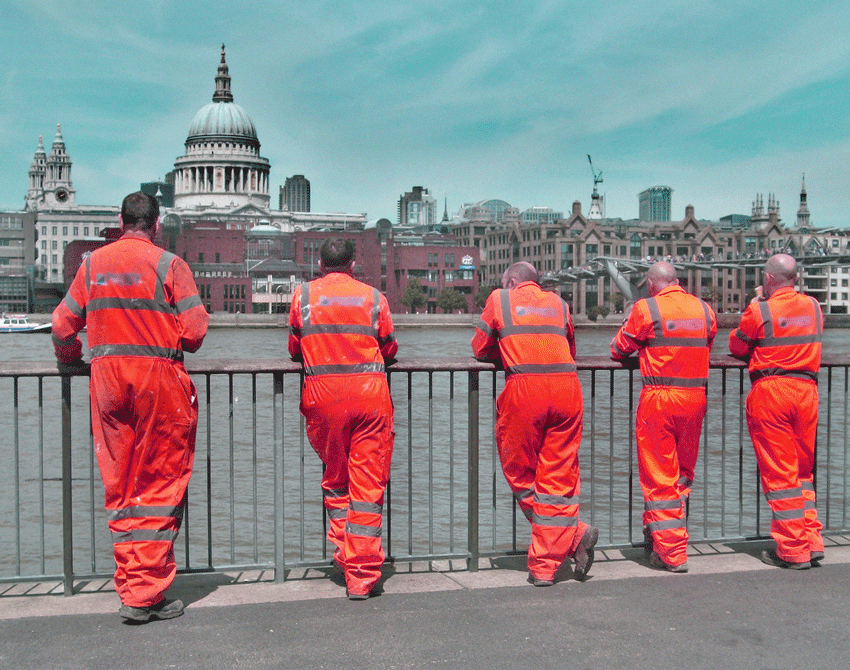
John Bellamy Foster is right that we mustn’t abandon the project of pursuing non-alienating work, nor simply see work as a disutility. Yet, there is clearly space for articulating the importance of reduced, reproductive and redistributed work, Nick Taylor finds, and systems of social security that support these circumstances, as part of efforts to deliver democratic control over meaningful work.

This blog is a transcript of Mike’s contribution to the conference Sustainability in Turbulent Times on 16 March 2016, reflecting on the implications of recent swings towards populism and nationalism around the world, for the relationship between inequality, democracy and sustainability.

We are rarely encouraged to think of ourselves as good ancestors, but that’s what we need to become. After all, we represent the past the future relies on to have a viable present. If the idea of Utopia invites us to imagine the future, Jonathan Rowson argues, it is up to us to make a path towards that future discernible in the present.

On 1st of March at the UKSSD Annual Conference: Unlocking the UK’s potential: from ambition to transformation, CUSP Co-investigator and GSI Director, Professor Aled Jones, ran a CUSP/Sustainability East breakout session on ‘Devolution, Brexit and the SDGs’. Lauren Stabler summarising the workshop.
Roger Scruton’s paper usefully enlarges the scope of our discussions in CUSP, bringing a wider range of concepts to bear on the question of “sustainable prosperity”. However despite this wide scope, Victor Anderson argues, there is inherent in his arguments a philosophical justification for nimbyism.

Savings and investment represent a fundamentally prudential aspect of human behaviour. They embody a commitment to a shared future. In this blog, Tim Jackson looks at what tomorrow’s economy will be like and what role investment plays in it.

For most of us—wherever we are in the world—work is a central component of our lives. Any Great Transition narrative wanting to connect with people has to address issues of work. How do we reorient the economy so that its values reflect our values rather than profit?

Scruton’s understanding of home or ‘oikophilia’ overlooks the patriarchal norms which govern these institutions, Malaika Cunningham argues in her response, this undermines his own argument against doctrines and ‘top-down’ structures.

Conservative thinking offers various necessary ingredients for any serious reflection on the meaning of ‘sustainable prosperity’. Yet, the relationship between sustainable prosperity and conservatism is a paradoxical one, Will Davies argues in his reply to Roger Scruton’s recent essay for CUSP.
The great humanistic emancipatory projects of the 20th century have run into the sand, leaving a non-humanistic one running riot: the Carbon Liberation Front. The rapid liberation of carbon molecules into the earth’s atmosphere is the dominant political programme of the 21st century, and neither state socialism nor capitalism provide any adequate response, it seems.

At CUSP we’re looking at sustainable finance from various angles. By combining transdisciplinary perspectives, we aim to provide a richer understanding of investment and shed light on issues that have hampered the development of a green economy and more sustainable forms of prosperity.

Academics must be conscious of the impact they create, Aled Jones and Alison Greig argue in their commentary, “even if that impact is unintentional. We must take responsibility for the action, or lack thereof, from the knowledge that we disseminate.”
Ecological Economist Federico Demaria was one of the panellist at our recent House of Commons debate on ‘Degrowth’ as an international movement gaining traction. Here’s his report on the challenges and tasks ahead.

What if we have known about our unsustainable destruction of the environment for a long time? Might we learn from our history of conscious ruin, and see more lucidly which institutions, social relations and modes of thought have perpetuated it?
Climate change is not an easy subject for politicians – they have to turn scientific consensus about the need for action into a workable agenda that can win people’s support. But how do politicians go about this? In this blog, CUSP fellow Rebecca Willis summarises her research findings.

Citizenship is not so undifferentiated as Melissa Lane’s paper makes out, Victor Anderson finds, and is every bit as diverse in the particular duties it implies. Professionalism matters, yes – but being a good citizen matters even more.
Environmental ethics cannot simply focus on the macro and the micro-levels of decision-making, Will Davies writes, when the sociology of contemporary capitalism compels us to consider the ethical commitments of institutions and authorities that operate between the two.

Paul Raskin’s Journey to Earthland is a thought-provoking essay that delivers an imaginative, compelling critique of societal problems, culminating in an ambitious description of a global eco-utopia.

Prosperity isn’t just about earning more and having more, it consists in our ability to participate meaningfully in the life of society. A vital element, Tim Jackson argues, that has gone missing for ordinary people over recent decades. We must question the fundamental structures behind our economies before they will work for everyone.
“Unlimited wants, scarce resources”– this is the economic problem, Dan Nixon finds. But once basic needs are met, how much should scarcity – having “enough” – be understood as a psychological problem? And what would it mean for how economics is taught?
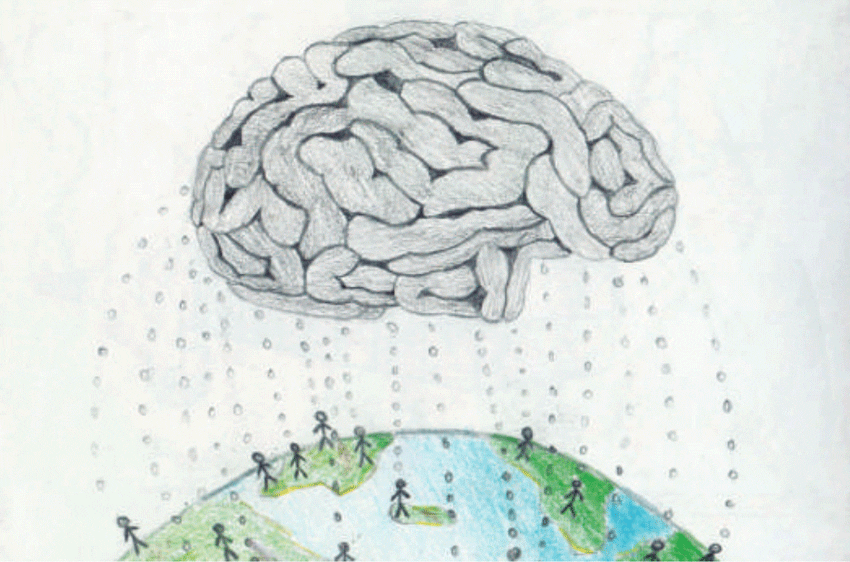
“When an idea is sketched on a page, it can be examined and discussed much more easily than when it merely exists in people’s heads.” In this blog, CUSP Fellow James McKay introduces his recent project: A dream of a low carbon future.

Jedediah Purdy’s history of the idea of nature in American thought provides an instructive context for contemporary environmental debate, Richard Douglas finds, but its idea of democracy founders on the absence of a vision of humanity’s purpose in a post-growth world.

In this blog, Research Fellow Craig Rye introduces a set of novel analysis techniques, drawn from ecology and physics, to better understand the changing behaviour of recessions and the business cycle (recession cycle) in historical GDP datasets.
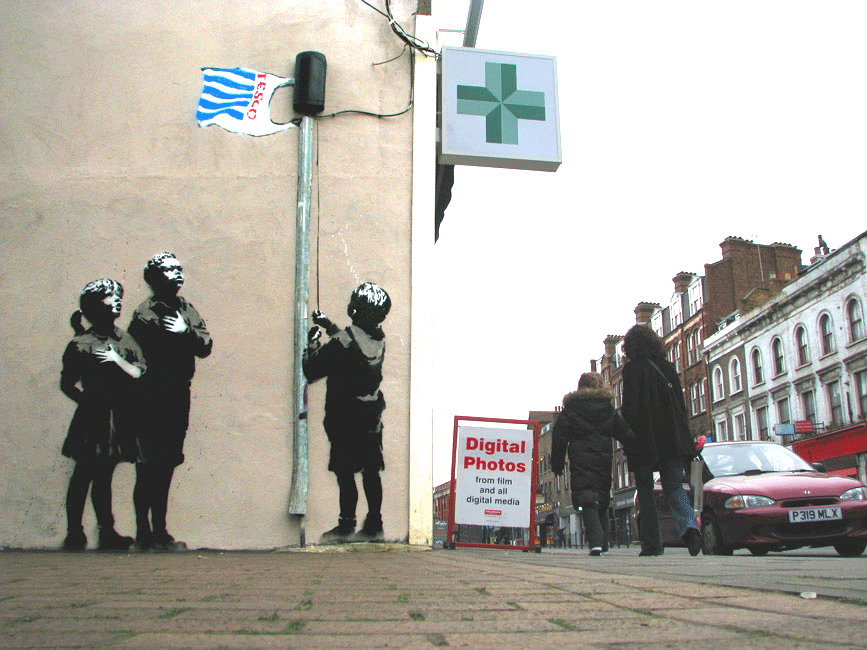
Barclay’s prosperity map has a very limited view of prosperity, focused almost entirely on financial wealth. Yet media reports have been entirely uncritical. We argue that this shows the power and dangers of measuring prosperity.

Our lifestyle today is widely considered to be the dominant influence on climate and the environment. The recognition of the Anthropocene as a new era calls for a new approach to politics, Marit Hammond argues; and the arts could play a key role.
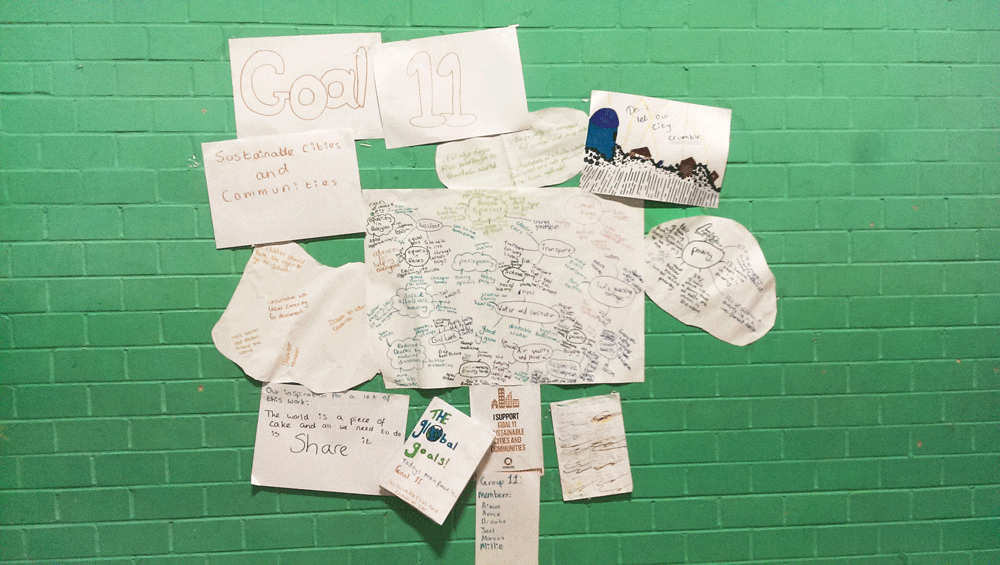
The Agenda 2030 forms an ambitious set of long-run goals. Yet, for those most affected, the year 2030 seems like a very long time in the future. How can we make the most of it and involve kids in the SDGs task, Sue Venn asks, reflecting on her participation at a recent Global Goals conference at Ken Stimpson Community School.

In order to find out what is sustainable, we need some understanding of what Earth’s limits actually are. The fairly new field of Earth System Science aims to provide the relevant information here, and this book by Tim Lenton is an introduction to its key aspects.
Small and medium sized enterprises are a dominant part of the global economy but get less attention than larger corporates in discussions about environmental issues. This opens up a fascinating debate, Fergus Lyon finds, about their role both within the ‘green growth’ agenda and the vision for ‘post-growth’ or steady state economics.
Bellamy Foster’s essay is to be warmly welcomed for putting the question of what constitutes ‘good work’ on the table. But by arguing – at least in parts – that good work looks like creative or artistic work, it risks perpetuating certain ideas about artistic production that will harm, rather than aid, the struggle for good work, Kate Oakley finds.