
PUBLICATIONS
As our work progresses, publications are arising from our research themes and cross-cutting projects. We produce working papers, journal articles, evidence submissions to government enquiries, essays, books and book chapters. Subscribe to our newsletter to receive a monthly digest in your inbox. If you want to hear more frequently from us, you can subscribe to email updates from the website directly.
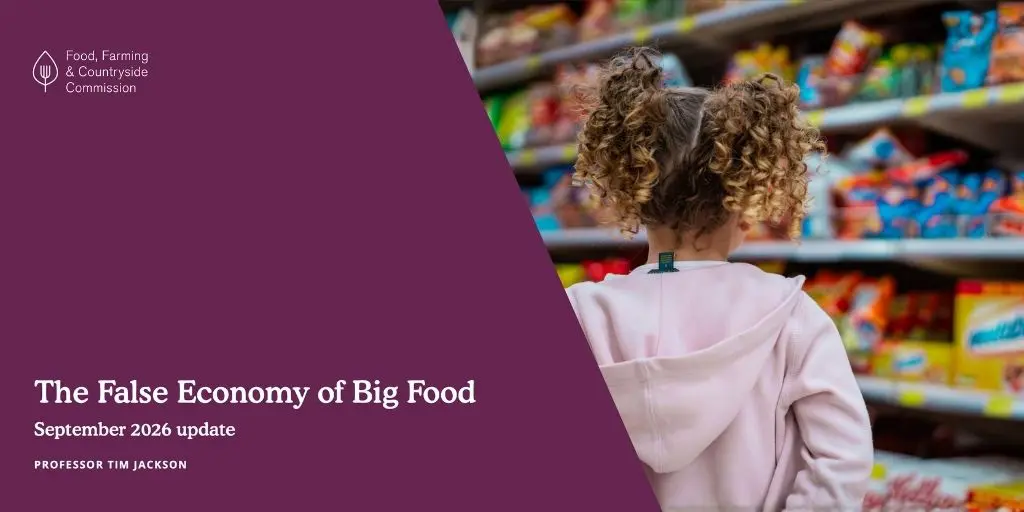
This report by Tim Jackson revisits two questions about the UK food system: what does diet-related ill health cost the nation, and what would it take to ensure everyone can afford a healthy diet? It updates the evidence from the 2024 FFCC False Economy of Big Food report and incorporates new research published since then.

What makes welfare states dependent on economic growth, and what could reduce the dependency? This paper reviews the existing literature on the issue, bringing together research on the key drivers of growth dependency and the policy responses that have been proposed.

How does everyday language shape our relationship with nature? This working paper by Amy Burnett et al examines how English idioms encode extractive relationships with nature and explores how regenerative language could support sustainability, nature-positive enterprise and ecological resilience.

The EAC is currently examining HM Treasury’s role in shaping the UK’s response to climate change and nature loss, including how long-term environmental risks are assessed in public investment. In evidence submitted to the inquiry earlier this year, CUSP co-director Tim Jackson examines the assumptions about economic growth, wellbeing and discounting that underpin the Treasury’s The Green Book guidance.

CUSP researchers Christine Corlet Walker and Dario Leoni examine how European healthcare and pension systems can become resilient in a post-growth economy, drawing on case studies from the UK, Italy, Finland and the Netherlands. The report explores how welfare systems can support wellbeing and reduce inequality without relying on continued economic growth.

In this paper, Seán Fearon et al. use time use analysis combined with emissions and wellbeing data to model 2050 lifestyles in Finland, France, and the UK, showing that while certain time use changes can improve wellbeing and reduce emissions, radical transformations in provisioning systems are still needed to stay within planetary boundaries.
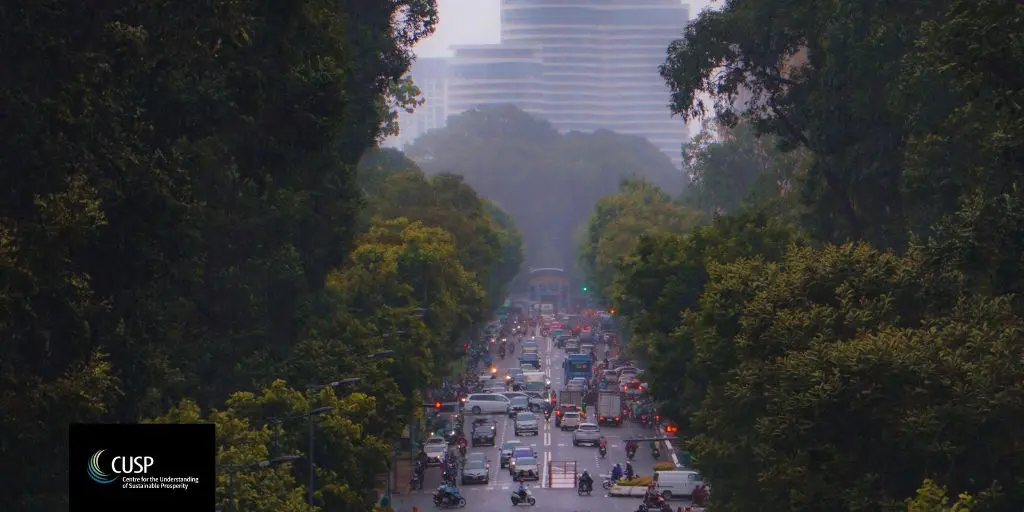
How can cities move beyond conventional approaches to sustainability? This research explores regenerative sustainability as a framework for transforming urban futures through holistic, place-based, collaborative approaches that support the flourishing of people and the wider living world.

A groundbreaking new report from Ernst & Young’s New Economy Unit (NEU) shines a harsh light on the extractivism which characterises modern capitalism and highlights the changes needed for corporate sustainability to move beyond incremental improvements towards a more equitable, resilient and regenerative economic system.
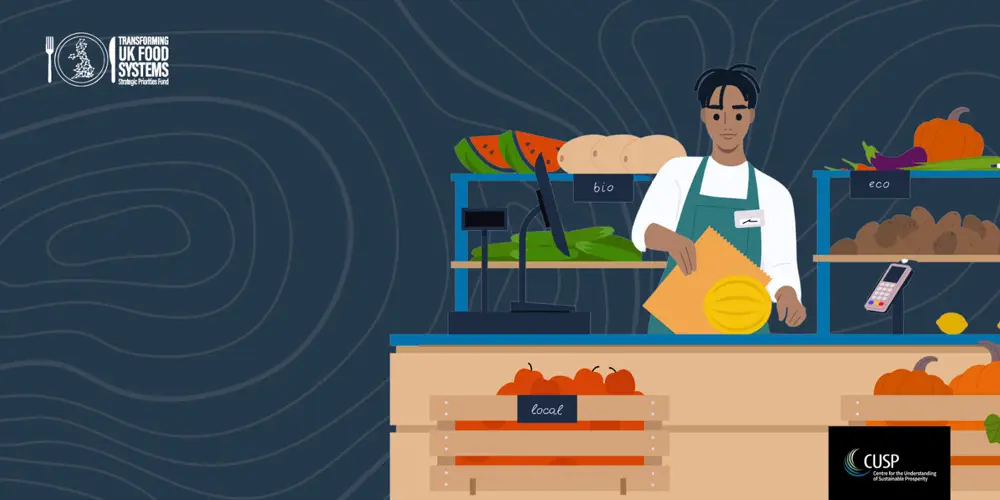
New briefing by CUSP researchers summarises evidence from the SEFS project on how social enterprises are contributing to healthier, fairer and more sustainable local food systems, and identifies policy actions to strengthen and scale their impact.

An unregulated post-growth transition in the North can cause crises in the South: debt, inflation, unemployment. That’s the finding of a new paper by Dario Leoni, Andrew Jackson and Tim Jackson. Their system dynamics simulations from the PADME model reveal that financial transfers and global cooperation are essential to make it work internationally—ecological space isn’t enough.
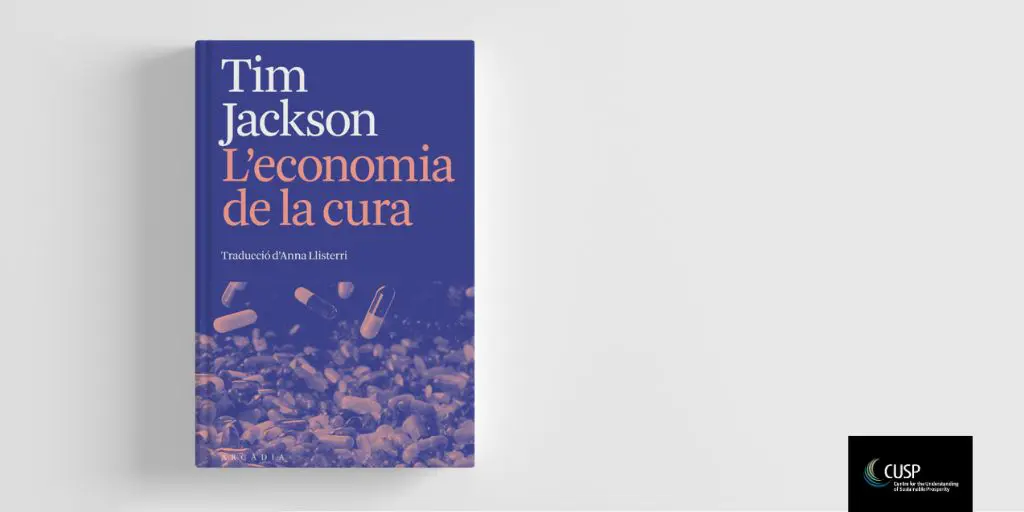
Tim Jackson’s “The Care Economy” now in Catalan from Arcàdia. A radical vision of prosperity rooted in health, not wealth. Translated by Anna Llisterri. With cover art by Joan Fontcuberta.

Small businesses make up almost all UK private enterprises and contribute to over half of greenhouse gas emissions—so why are they still missing from green finance policy? Drawing on 80 interviews and 10 case studies, the study traces how nature-positive investment trickles down too slowly, finds SME innovators already ahead of regulation, and reveals a persistent gap where private finance waits for first-movers.

Commissioned by Beyond Fossil Fuels and Friends of the Earth Ireland, a new report by CUSP research fellow Seán Fearon models how the constant, inflexible, and rising share of data centre demand on the Irish electricity grid is pushing up electricity prices for households across the state.

What does prosperity really mean? For CUSP co-director Prof Tim Jackson, the answer lies not in wealth but in health—and in the principle of care. In a recent discussion inspired by his new book The Care Economy (2025) and his keynote at the SCORAI Europe Conference in Lund, Sweden, Tim sat down with researchers Halliki Kreinin and Jonas Ludwig to explore how care might serve as a fundamental organising principle for postgrowth societies.

Maria L. Granados and Adeyemi Adelekan show how waste management social enterprises in Nigeria & Colombia embed empowerment into circular activities, enabling marginalised groups to participate in economic and civic life.
In their new book chapter, Oksana Mont, Amy Isham, and Patrick Elf debunk the “more choice is better” myth. They show how choice overload leads to paralysis, overconsumption, and waste—even with green products. Using examples from food, tourism, and clothing, they argue that fewer choices support sustainable habits and fairness, offering practical policy ideas like capping options.
Chronic disease, early onset multimorbidity and widening inequality aren’t healthcare failures—they reflect the conditions in which health is produced. Tim Jackson’s working paper for Enlighten’s NHS 2048 initiative reframes prosperity as health and calls for recentring care as essential infrastructure to align policy with long-term health outcomes.

Two new reports on London’s green economy, commissioned by the London Councils Green Economy Programme, explore how the capital can reach net zero while supporting local businesses and workers, highlighting fragmented SME support, green skills gaps and the need for coordinated action.

Against the backdrop of an urgent need for change of the fashion and textile industry towards more sustainability, this new research report explores how nature positive action can be embedded in UK Textile and Fashion SMEs. It examines what financial and other support is required to achieve this, and how SMEs can develop their environmental reporting to aid investors and other stakeholders in making decisions.
This book chapter by CUSP researcher Amy Isham examines how materialistic values, embedded within consumer capitalist societies, contribute to environmental violence and undermine physical and mental health. Drawing on psychological research, it explores how flow experience—states of deep immersion in meaningful activities—may offer an antidote by supporting human wellbeing, encouraging self-transcendent values, and enabling more sustainable ways of living.
Climate breakdown should be understood as a profound abdication of care, argues CUSP co-Director Tim Jackson in an opinion piece commissioned for the British Medical Journal’s (BMJ’s) new year special issue on climate change. Addressing that failure will take more than clever technology or incremental policy reform. It must start by reimagining the purpose of the economy and the direction of societal progress.
New report examining the rapidly evolving UK early-stage green innovation finance landscape, exploring how start-ups and their investors navigate complex funding pathways to support nature-positive business models. Drawing on extensive stakeholder insights, it highlights both the growing momentum and the significant gaps in measuring, financing, and scaling SME innovations that can embed biodiversity and nature value into investment decisions.

This study by Shimaa Elkomy and Tim Jackson examines how air pollution and CO₂ emissions affect global health—and whether stronger healthcare systems can soften these impacts. The findings show that while robust health systems help, they cannot counteract the long-term harms of rising emissions. Strengthening health systems remains crucial, but it must be paired with emission reduction strategies and stricter environmental regulations to effectively safeguard public health.

To accompany the launch of the latest report by the UK’s Food, Farming and Countryside Commission, Prof Tim Jackson explores the hidden costs of our national diet, asking who truly bears the price of a booming fast-food industry and what it means for our health, communities, and environment.

Using representative surveys in the UK and US with over 5,000 participants, a new study by CUSP fellow Dario Krpan and colleagues Fred Basso, Jason Hickel, and Giorgos Kallis finds that—contrary to common political and media claims—the majority of respondents support degrowth when presented with the full proposal, regardless of the label.

CUSP fellow Richard Bampfylde served as lead researcher and author of the new BKMC policy report, which aims to inspire young people to pursue positive social, environmental, and economic initiatives while encouraging policymakers to adopt more sustainable perspectives and behaviours.

New paper by Patrick Elf, James Ferreira Moura Junior and Amanda Kumaruara, calling for rapid unlearning of harmful modern practices by learning from Indigenous teachings—toward a decolonised, caring, and sustainable future.

In this book, Richard Douglas uncovers the cultural roots of resistance to environmental action. Through a close reading of anti-environmentalist rhetoric, he shows how faith in progress and endless growth shapes modern politics and blocks meaningful responses to ecological crises.

Wellbeing feels out of reach for most people. This paper, written by a range of economists and practitioners in the field of New Economics, explores why this is the case and proposes an alternative modus operandi, setting out key interdependent functions that each actor in the economy might play.

In high-income countries, where continued economic expansion may no longer be possible or desirable, the future of work is increasingly debated—often with conflicting views on labour productivity. This paper examines the role of labour offshoring in shaping productivity gains and considers the implications for post-growth proposals.

This study investigates where people experience flow today, drawing on UK and international survey data. It examines both the activities and physical environments associated with flow, offering updated insights into how everyday spaces may support psychological wellbeing.

How do people in post-industrial cities imagine a better future? Kate Burningham and Sue Venn explore how memories of the past and critiques of everyday struggles today help shape hopeful visions for tomorrow in Stoke-on-Trent—arguing that reflecting on local life can lay the groundwork for collective, community-led regeneration.
This paper examines how slower growth in advanced economies may force a choice between fiscal tightening and rising debt. It shows that more flexible approaches to monetary and fiscal policies can better support debt stability and long-term economic, social and environmental goals.

In a new Nature comment piece, CUSP researcher Dr Dario Krpan and colleagues are making the case for integrating psychological and behavioural sciences into the study and implementation of degrowth.
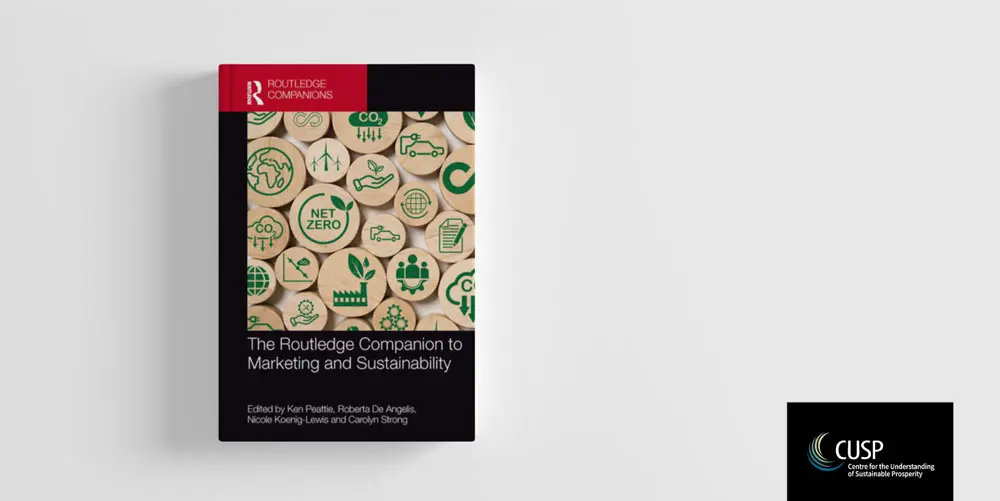
Promoting sustainable lifestyles requires a shift away from marketing strategies that reinforce unsustainable consumption. This book chapter considers how marketing can be reoriented to support more equitable, resilient, and environmentally responsible ways of living.

Ecotherapy is a nature-based approach that supports mental and physical wellbeing while helping reduce environmental impact. This article explores its potential benefits, including improved health outcomes and sustainability, and highlights the need for training and standardised practice for wider adoption.