
THEMES / POLITICS & ENTERPRISE / SME FinBio
Nature positive SME finance
Funded by UKRI and the Natural Environment Research Council (NERC), the broad aim of this project is to explore SME finance markets in four high-risk environmental impact sectors: agrifood, infrastructure, sustainable fashion and advanced manufacturing technology. The project builds on previous research, which identified constraints and opportunities for SMEs and their financiers to account for climate and biodiversity in a cohesive and meaningful way; laying the ground for more sector specific work now.
Contact
Robyn Owen, PI: r.owen@mdx.ac.uk
CEEDR, Middlesex University Business School
London NW4 4BT
Please be in touch if you have questions. We also share project updates on LinkedIn.
 |
Challenge
Business and finance play a key role in advancing the biodiversity and climate change mitigation agenda. Small and medium-sized enterprises (SMEs) are businesses with under 250 employees and represent the majority of the private sector (99% of businesses and over half of the jobs). Yet, they receive very little attention in the quest.
Financial reporting frameworks and standards play a big role in guiding the format and requirements for sustainability reporting. But while discussions around large companies and their reporting standard are thriving, guidelines adopted for SME needs are almost nonexistent. This overlooks both the overall economic contribution of SMEs, as well as their environmental impacts.
There is a risk that the challenges that SMEs face are dissuading investors, at a time when innovations to tackle biodiversity loss are needed most. Information asymmetries in novel and emerging sectors, as laid out by Owen et al (2022), due to the lack of clarity in defining biodiversity impacts with related Science Based Targets (SBTs) are a major barrier. This project has set out to address this issue.
Aim
The aim of the project is to address the following questions:
- What is the current understanding amongst SME investors regarding approaches to measuring and reporting on biodiversity?
- How do SME innovators that are developing new business models for nature positivity and net zero currently report on their impacts?
- How can measures and metrics (e.g. Science based targets) be made suitable and practically operational for SMEs and their investors?
- What are the effective ways to assist SME investors and investees seeking nature positivity and net-zero? How do investors collaborate to develop common approaches that reverse biodiversity depletion?
Our research examines the constraints investors and investees face when reporting on biodiversity. It will explore the required steps to encourage a support ecosystem for both investors and SMEs so they can assess nature and carbon impacts within a burgeoning industry around biodiversity reporting for SMEs and other businesses.
The study will examine four high-risk and potentially high net-gain impact sectors:
- Agri-food
- Infrastructure (transport and construction and appliance of biodiversity net gain)
- Fashion and textiles
- Ecological measurement services (sectors offering tech for mitigating and measuring biodiversity)
Across all of these, we will examine the diverse sources of finance, such as banks, supply chain finance, and early-stage equity investors (e.g., venture capitalists, business angels, accelerators).
Case studies
What can we learn from SMEs innovating around nature-positive business models and how they operate? Insights from our case studies cover novel approaches in finance, in the agri-food sector, freight and logistics, planning and construction, the fashion and textiles industry, as well as environmental measurement, and tech services.

SME Nature Positive Innovation Finance Report: Early-stage nature positive innovation finance in the UK
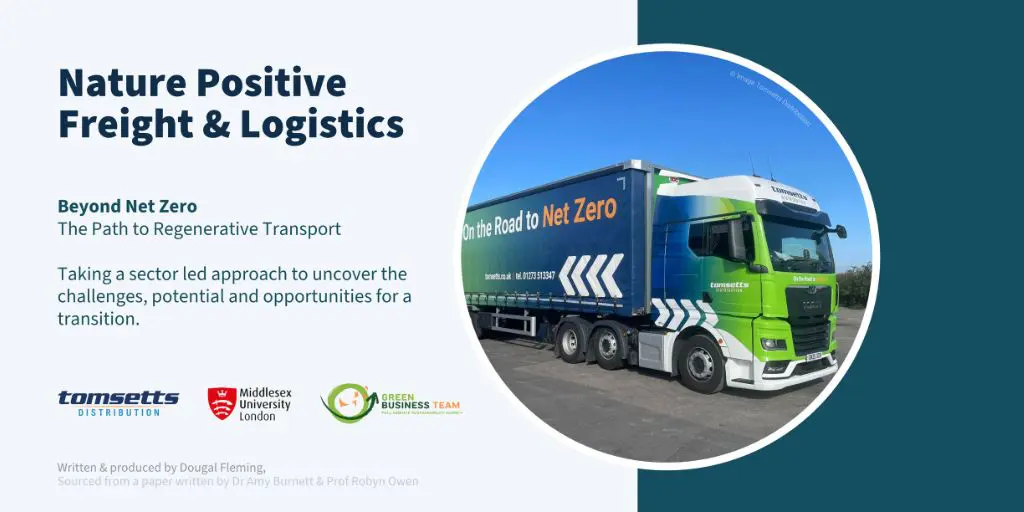
This report by Dougal Fleming examines the current environmental impacts of the freight and logistics sector, the implications of inaction, and the case for reducing CO2e through measures like product elongation. It also inspires industry leaders to enrich ecosystem services and give back more to nature than they take, highlighting five key areas for companies to consider and how to get started.
SME Nature Positive Innovation Finance Report: Early-stage nature positive innovation finance in the UK
New report examining the rapidly evolving UK early-stage green innovation finance landscape, exploring how start-ups and their investors navigate complex funding pathways to support nature-positive business models. Drawing on extensive stakeholder insights, it highlights both the growing momentum and the significant gaps in measuring, financing, and scaling SME innovations that can embed biodiversity and nature value into investment decisions.

Support For SMEs’ Contributions to Tackling the Nature and Biodiversity Crisis in the Fashion and Textile Industries
Against the backdrop of an urgent need for change of the fashion and textile industry towards more sustainability, this research report, written by Andrea Werner and Mila Burcikova, explores how nature positive action can be embedded in UK Textile and Fashion SMEs. It examines what financial and other support is required to achieve this, and how SMEs can develop their environmental reporting to aid investors and other stakeholders in making decisions.

Video Presentation
Business models for regenerative systems | Transforming UK Foddsystem Connect Series, June 2025
Reports
- Biodiversity in the Freight and Logistics Sector: Land-based impacts and green warehousing. Interim Report, June 2024.
Related posts











Project partners
The study builds on UK-based networks comprising impact investor groups, business case studies and support agencies. Key partners include early-stage investors, banks, financial intermediaries (notably ESG advisors), and small business support and representative organisations.
Ecologists and business reporting specialists work together to explore the approaches being used, the metrics being prioritised, the methodologies used to assess impact, and the technology being developed to reduce the costs and extend the depth and accuracy of analysis.